
THE
SCHLIEFFEN PLAN DEBATE 1999-2011
In 1999 ‘The
Schlieffen Plan Reconsidered’ appeared in War in History. It contended
that the Schlieffen plan, one of the pillars of 20th-century
military history, had never actually been the German war plan, which caused
considerable controversy and ruffled the feathers of some very senior
historians, a number of whom were on the record as saying that the Schlieffen
plan had been the German war plan. They had also concluded that the Schlieffen
plan was the proximate cause of the Great War and emblematic of rigid German
planning and German militarism. Their opposition had already caused an American
military history journal to reject ‘The Schlieffen Plan Reconsidered’. Prof.
Hew Strachan, the Chichele Professor of Military History at All Souls, Oxford,
and co-editor of War in History, published it with the express
intent of stimulating a debate.
That debate began
in 2001 and continues to this day. It comprises sixteen journal articles, all
but one which have appeared in War in History: four by Terence Holmes,
two by Robert Foley, one by Annika Mombauer and one by Gerhard Gross, plus my
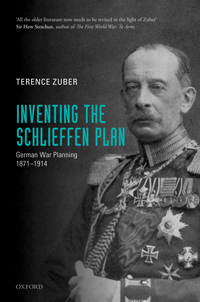
rebuttals. In addition, Inventing the Schlieffen Plan, which expanded on
The Schlieffen Plan Reconsidered’, was published by Oxford UP in 2002, and The
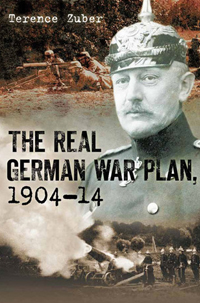
Real German War Plan 1904-1914 by the History Press in 2011.
The Schlieffen
plan debate has become one of the longest and most extensive debates in modern
military history. The sixteen journal articles of the debate comprise 290 pages
of complex text. This is too long for almost anyone to read. The following
summaries reduce the debate to a more-manageable 77 pages.
For reasons of
copyright, it was not possible to summarize the articles by Holmes, Foley,
Mombauer and Gross. Each of their articles is given a paragraph-long ‘executive
summary’. My rebuttal is given an extensive summary, which itself requires a
restatement of my opponent’s position. Due to the need to describe
newly-discovered documents in detail, my last two debate pieces are longer.
PUBLICATIONS
T. Zuber, 'The Schlieffen Plan Reconsidered' in: War in History,
1999 (3) pp. 262-305.
T. Holmes, 'A Reluctant March on Paris', in: War in History,
2001 (2) pp. 208-32.
T. Zuber, 'Terence Holmes Reinvents the Schlieffen Plan' in: War in
History 2001 (4) pp. 468-76.
T. Holmes, 'The Real Thing' in: War in History, 2002 (1) pp.
111-20.
T. Zuber, Inventing the Schlieffen Plan: German War Planning
1871-1914 (Oxford University Press, 2002)
T. Zuber, 'Terence Holmes Reinvents the Schlieffen Plan - Again' in: War
in History 2003 (1) pp. 92-101.
R. Foley, 'The Origins of the Schlieffen Plan' in: War in History,
2003 (2) pp. 222-32.
T. Holmes, 'Asking Schlieffen: A Further Reply to Terence Zuber' in: War
in History 2003 (4) pp. 464-479.
T. Zuber, 'The Schlieffen Plan was an Orphan' in: War in History,
2004 (2) pp. 220-25.
R. Foley, ‘The Real Schlieffen Plan’ in: War in History, 2006
(1) pp. 91-115.
T. Zuber, ‘The ‘Schlieffen Plan’
and German War Guilt’ in: War in History 2007 (1) pp. 96-108.
A. Mombauer, ‘Of War Plans and War Guilt: The Debate Surrounding the
Schlieffen Plan’ in: Journal of Strategic Studies XXVIII, 2005.
T. Zuber, ‘Everybody Knows There Was a ‘Schlieffen Plan”: A Reply to
Annika Mombauer’ in War in History 2008 (1) pp. 92-101.
G. Gross, ‘There Was a Schlieffen Plan: New Sources on the History of
German War Planning’ in: War in History 2008 (4) pp. 389-431.
T. Holmes, ‘All Present and
Correct: The Verifiable Army of the Schlieffen Plan’, in: War in History
2009, (1) pp. 98-115.
T. Zuber, ‘There Never was a “Schlieffen Plan”: A Reply to Gerhard
Gross” in: War in History 2010 (2) pp. 231-249
T. Zuber, ‘The Schlieffen Plan’s “Ghost Divisions” March Again: A Reply to Terence Holmes’ in: War in
History 2010 (4) pp. 1-14
T. Zuber, The Real German War Plan 1904-1914 (The History Press,
2011)
SUMMARIES
‘The Schlieffen Plan Reconsidered’
by Terence Zuber in: War in History 1999 (3) pp. 262-305.
The Schlieffen plan is so well-known that it has become ‘common
knowledge’ which requires no verification: it was an aggressive war plan which
promised Germany victory over France in 42 days andt also proves German war
guilt.
Comparing the ‘common knowledege’ Schlieffen plan to the actual
Denkschrift shows consideable discrepancies. ‘Common knowledeg’ says that the
Schlieffen plan was intended for a two-front war against France and Russia: the
actual Schliefen plan Denkschrift was for a one-front war against France. The
Denkschrift required an army of 96 divisions, but only 72 were available in
1906 and only 68 on the west front in 1914: the Schlieffen plan was based on at
least 24 “ghost divisions”.
In any case, aside from the
Schlieffen plan Denkschrift, almost nothing was known about German war planning
from 1891 to 1914. With the fall of the Berlin Wall German war-planning
documents, which had been held by the East Germans, became available for the
first time, including a manuscript describing Schlieffen’s war planning to
1904. In addition, a number of Schlieffen’s war games were found in the
Bavarian army archives.
These documents show that up to
1904 there was no trace of the Schlieffen plan. In fact, Schlieffen intended to
counter the expected coordinated Franco-Russian attack by using Germany’s
central position and the mobility provided by her rail net to counterattack
against first one opponent, then the other. This is the theme of Schlieffen’s
last wargame.
Schlieffen wrote the
‘Schlieffen plan’ Denkschrift to argue for a massive increase in the size of
the German army, and not a war plan that involved the use of 24 ‘ghost
divisions.’
The history of German war
planning prior to the First World War has been dominated by the ‘Schlieffen
plan’, which was developed in a Denkschrift
(study) written in early 1906 by the recently retired Chief of the German
General Staff, Count Alfred von Schlieffen. The Denkschrift assumed a
one-front war against France (and later, Britain). No forces needed to be sent
to protect East Prussia against the Russians. Schlieffen’s concept for this war
plan was to deploy seven-eighths of the German army between Metz and Aachen, on
the right wing of the German front, leaving one-eighth of the army to guard the
left flank in Lorraine against a French attack. The right wing of the western
army would sweep through Belgium and northern France, swinging to the west of
Paris, continually turning the French left flank, eventually pushing the French
army into Switzerland. If the French attacked the German left, in Lorraine,
they would be doing the Germans a favor, for the attack would accomplish
nothing and the French forces in the north would be that much weaker.
Beginning in 1920,
semi-official histories written by retired First World War German army officers
such as Lieutenant Colonel Wolfgang Foerster, General Hermann von Kuhl and
General Wilhelm Groener, as well as the first volume of the official history of
the war produced by the Reichsarchiv in 1925, maintained that this Denkschrift represented the culmination
of Schlieffen’s military thought, and provided Germany with a nearly infallible
war plan: all that Schlieffen’s successor, Helmuth von Moltke, had needed to do
was to execute the Schlieffen plan, and Germany would have been practically
assured of victory in August 1914. They maintained that Moltke did not
understand the concept of the Schlieffen plan, and modified it by strengthening
the forces on the left wing at the expense of the main attack on the right. For
this reason, the German army failed to destroy the French army in the initial
campaign in the west in 1914.
After the war, the Reichsarchiv
in Potsdam, which was the custodian of the pre-war German plans, treated them
as classified documents, access to which was essentially restricted to reliable
retired officers, such as Foerster, Kuhl, and Groener. These men emphasized the
Schlieffen Denkschrift and revealed
practically nothing of Schlieffen’s other war plans written between 1891 and
1905.
The Reichsarchiv also pronounced
the damnatio memoriae on the failed Chief of Staff of 1914, Helmuth von Moltke:
all that we know of his planning is that around 1909 he conducted the fatal
modification of the Schlieffen plan.
Since the Reichsarchiv, and
with it all of Schlieffen’s and Moltke’s war plans, was destroyed by British
incendiary bombs on the night of 14 April 1945, any analysis of German war
planning has had to be made, with a few unimportant exceptions, on the basis of
the fragments of information provided by the official history and the retired
officers.
Hans Delbrück, who had been conducting a prewar debate on strategy
with the German army, responded that Germany had used the wrong war plan. It would have been wiser to attack in the east and defend in
the west: this was, Delbrück said, after all the plan of the great Field
Marshal von Moltke between 1871 and 1888. An offensive in the east – an Ostaufmarsch – would have produced a
quick, easy victory over the Russian armies in Poland. Germany could have also
respected Belgian neutrality, which would have seriously weakened British
enthusiasm for the Entente. The debate between the General staff officers and
Delbrück continued up to the Second World War.
Between World War I and the
1990s, only one group of original German war planning documents has come to
light, this being the original drafts and copies of Schlieffen’s Denkschrift, which Gerhard Ritter found
in Schlieffen’s papers being held after World War II in the National Archives
in the United States. Ritter published these along with a critical commentary
in 1956 in his book Der Schlieffenplan:
Kritik eines Mythos.[1] For Ritter, there was no
question that this Denkschrift was
the culmination of Schlieffen’s strategic thought and the template for all
subsequent war plans. Ritter also thought the plan was inflexible, very risky,
and had little chance of succeeding. Ritter made the Schlieffen plan the
central piece of evidence in his indictment of German militarism. The
Schlieffen plan was war-planning run amok, the ‘purely military’ plan ‘based on
military theory rather than on the realities of history and politics’. The
violation of Belgian neutrality was a catastrophe: ‘The entire world criticized
Germany for being led and ruled by unscrupulous Militarists...seen from the perspective
of later events (the Second World War), the Schlieffen plan appears to be the
beginning of the German and European disaster.’
Subsequent historians have based
their description of German war planning on Kuhl, Foerster, Ludendorff,
Groener, and above all, Ritter.
The actual Denkschrift
emphasizes two facts. The first is that the Schlieffen plan was intended for a
one-front war against France and Britain. However, in 1914, Germany faced a
two-front war with Russia, too. Second, the Denkschrift required an army
of 96 divisions, but only 72 were available in 1906 and only 68 on the west
front in 1914. The Schlieffen plan was based on at least 24 ‘ghost divisions’.
In addition, Foerster told Ritter that Schlieffen, who had retired on 1 January
1906, had actually written the Denkschrift in January and February of
that year and not, as it had been assumed, in 1905.
In comparison
with Schlieffen’s exercise critiques, the Denkschrift is poorly
organized. Schlieffen discussed the complete operation in the first
three-quarters of the Denkschrift, then in the last quarter picked up at
the very beginning and went through the conduct of the operation again. In a
General Staff where orders were short, crisp and clear, such verbosity was poor
form. . In February, Schlieffen found it necessary to write a supplement to
cover the possibility of British intervention.
Schlieffen was
also not entirely clear about how he would deal with a French attack into
Lorraine. At one point, he says that such an attack would be doing the Germans
a favor (Liebesdienst) because the pressure exerted by the right-wing
envelopment would force the French to pull all their forces to the north. At
another point he says that the Germans should…shorten up the right wing and
turn directly south….as an operations order, the Schlieffen plan Denkschrift
is a horror.
German
unification resulted in the discovery of some German war planning documents in
the East German military archives. The most important of these is Major Dr.
Wilhelm Dieckmann’s Der Schlieffenplan, a summary of Schlieffen’s war
planning until 1904. Dieckmann’s manuscript makes it clear that a thread that
ran through all of Schlieffen’s planning: the concern that the German army was
not strong enough for a two-front war. Schlieffen continually advocated
strengthening the army by incorporating all reservists into maneuver units and
by instituting universal conscription. Indeed, the German army was not even
strong enough for an offensive one-front war in the west, and Schlieffen never
wrote such a plan. The problem was that the French had fortified their border
with Germany. Schlieffen noted in 1897 that an attack through Belgium to avoid
this zone would result in the German army being divided in half, with the French
free to concentrate on one half and destroy it. One of Schlieffen’s senior
subordinates, Hans von Beseler, did write a plan in 1900 to attack through
southern Belgium, but its objective was to break the French fortress line by
attacking it from the front and rear, not annihilate the French army.
The German
planning year ran from 1 April to 31 March of the next year. Deployment (Aufmarsch)
plans were therefore designated by those two years. From 1891/92 until October
1899 Schlieffen deployed 2/3 of the German Army in the east and 1/3 in the
west. In October 1899, Schlieffen developed two deployment plans: Aufmarsch I,
when it was thought that the Russians would not attack in strength deployed 58
divisions in the west and 10 in the east. Aufmarsch II, for the usual
two-front war, deployed 45 divisions in the west and 23 in the east.
In the 1900/01
plan, Schlieffen’s Aufmarsch II was an Ostaufmarsch: 44 divisions
were to be deployed in the east and only 24 in the west. In conjunction with
some 30 to 40 Austrian divisions, the Austro-Germans would have had, at least
initially, a considerable superiority in the east. On the other hand, deploying
44 divisions using the only three available rail lines would have been very
time-consuming, scarcely faster than the Russian deployment, and most of these
divisions would detrain not in East Prussia proper but along the Vistula River
farther to the west. There is no indication as to Schlieffen’s concept of the
operation. It is likely that Schlieffen hoped that he would put so much
pressure on the Russians that the French would be forced to leave their
fortifications and attack to rescue them. It appears that Schlieffen would have
retained the mass of his forces in the west in their garrisons, and when the
French attacked, used rail mobility to mass and counter-attack. Schlieffen
retained the Ostaufmarsch in 1901/02, but in 1902/03 turned to the
former plan, with 1/3 of the army in the east and 2/3 in the west.
According to the
‘Schlieffen School’, during his entire tenure as chief of staff, Schlieffen was
single-mindedly developing the Schlieffen plan. Dieckmann’s manuscript shows
that this is incorrect. Schlieffen was interested in a decisive victory, and
there were several methods to accomplish this.
From a number of
sources, including Dieckmann, as well as Schlieffen’s Generalstabsreisen
West (General Staff rides in the west), which were found in Freiburg and in
the Bavarian archive in Munich, and the Generalstabsreisen Ost (General Staff
rides in the east) published in 1938, it is clear that from 1898 onwards
Schlieffen’s long-term goal was to compensate for German numerical inferiority
in a two-front war by developing a counterattack doctrine. He assumed that the
French and Russians would launch a coordinated and nearly-simultaneous joint
offensive He would use German rail mobility to mass and counterattack against
one of these offensives, then use Germany’s interior position and rail mobility
to mass on the other front and counterattack there. In either case, it was
important to fight near the German border, close to the German railheads, and
not plunge into the interior of either France or Russia.
The 1905 Generalstabsreise
West, described in 1938 by Generalleutnant Zoellner in an article
titled ‘Schlieffen’s Legacy’, shows Schlieffen’s mature planning for operations
in the west. Schlieffen played the German side against three General Staff
field-grade officers. The German army deployed from Lorraine to the border with
Holland. In the first scenario Lieutenant-colonel Freytag-Loringhoven’s
solution was to attack into Belgium. Schlieffen responded by counterattacking
against the French left and from Metz against the French right, defeating the
French army. In the second scenario, Colonel Steuben attacked into Lorraine.
Schlieffen moved the 3rd Army from the right wing to Strasbourg,
while two more right-wing armies marched to the east of Metz. Schlieffen then
counterattacked against the French flanks, using the fortresses of Strasbourg and
Metz as jumping-off points. In the third scenario, Major Kuhl attacked on both
sides of Metz. Schlieffen again sent forces from the right wing to reinforce
the left and defeated the French attack in Lorraine. This exercise was the
capstone of all of Schlieffen’s exercises in the west.
The 1905 Generalstabsreise
West had nothing to do with the Schlieffen plan. In the Generalstabsreise
the French are attacking and the Germans counter-attacking; in the
Schlieffen plan the French are on the defensive and a French attack into
Lorraine should be ignored. In the Schlieffen plan it was essential to ‘keep
the right wing strong’; in the Generalstabsreise, the right wing moves
to directly reinforce the left. In the Schlieffen plan the decisive right-wing
attack sweeps to the west of Paris; in the Generalstabsreise the German
army fights in Belgium and Lorraine.
In November and
December 1905 Schlieffen played his last exercise, a massive two-front, 42-day Kriegsspiel,
perhaps the greatest war-game in military history. For advocates of the
Schlieffen plan, as well as those such as Ritter who saw in Schlieffen only
aggressive militarism, this war-game is a bitter disappointment, for in this,
Schlieffen’s last and greatest exercise, the Germans conducted a strategic defensive
on both fronts.
Schlieffen
deployed 16 divisions in East Prussia. When the Russians attacked on the 27th
day of mobilization with 33 divisions, he sent another 22 German divisions by
rail and counterattacked on the 30th day, turning the Russian flanks
and destroying both Russian armies. On the 33rd day he began to
transfer forces west.
In the west, the
French and British massively outnumbered the Germans. On the 23rd
day the French attacked into Lorraine and Belgium, and both Belgium and Holland
allied themselves to Germany. Schlieffen moved the south German corps by rail
to Lorraine and counterattacked, driving the French out, and on the 27th
day he transferred three corps to Antwerp, which the French reached Antwerp by
the 31st day. On the 33rd day the Germans counterattacked
out of Antwerp , and by the 37th day had surrounded the left-flank
armies and crossed the Meuse at Namur. On the 39th day the Germans
counterattacked from Metz against the French right flank and by the 42nd
day the French main body was surrounded in the Ardennes.
Historians have assumed that in
the Schlieffen plan Denkschrift,
which was written in early 1906, Schlieffen could afford to leave East Prussia
undefended because the Russian army had been made combat ineffective by the effects
of the Russo-Japanese war and the Russian revolution of 1905. The 1906[2]. German intelligence report
said that the Russians could still deploy about 25 infantry divisions against
Germany and 22 infantry divisions against Austria (as opposed to a pre-1904
deployment of 30 divisions against Germany, 30 against Austria). Now there are
two massive inconsistencies in the Schlieffen plan: the wholesale use of
non-existent units and leaving East Prussia undefended against an invasion by
25 Russian divisions. The only possible conclusion is that the ‘Schlieffen
plan’ Denkschrift was not a war plan
at all.
Ritter, and those who followed
him, did not understand the Denkschrift
because they stood it on its head. The point was not to develop a radically new
scheme of maneuver, but to readdress the issue which Schlieffen had felt
throughout his career to be the most serious problem facing the German army:
Germany’s failure to utilize exhaustively either her trained manpower or her
total available manpower. In the Denkschrift,
Schlieffen employed the total German force and added to it all the units he
thought could be raised using Germany’s trained manpower: given equipment and
prior planning, reserve corps could be created from reserve divisions and
ersatz divisions created outright by using trained reservists. Schlieffen had
been recommending such a course of action since 1889. Using this expanded
force, he then discussed the campaign that could be conducted. In any case,
Schlieffen said the German army was probably too weak for such an operation.
The obvious implication was that if Germany wanted to be able to meet any
eventuality, she needed even more maneuver units and must raise an army based
on universal conscription as the French had done.
The Schlieffen plan file
consists of Schlieffen’s handwritten draft, covered with additions and
deletions, and a typed copy, with Moltke’s marginal comments, which is dated
1911: the only conclusion one can draw is that Moltke did not even look at the Denkschrift
until 1911. In addition, famous Schlieffen plan map was drawn in 1911 too.
It shows only one thing: how long it would take to march to the Somme. The
answer is: to the 31st day of mobilization. It also shows the march
around Paris but does not even bother to measure how long it would take: an
educated guess would be at least another 20 days or to the 51st day
of mobilization. Even if the campaign ended at this point (and there is one
arrow pointing generally from Fontainbleau towards Langres, 200 kilometers
away), in a two-front war it would take nearly as long again to march the
troops back to German railheads for transfer east. Advocates of the Schlieffen
plan usually say that it would have given the Germans a decisive victory in 30
to 40 days. By the 40th day the right wing had not even
circumnavigated Paris.
In 1911 the question of
radically increasing the size of the German army was becoming acute. Since
Schlieffen’s Denkschrift addressed
just such a problem, Moltke directed that it be re-evaluated. The only part of
the operational problem in the Denkschrift
with which Moltke was not intimately familiar was the march around Paris, so
the map was made to answer that question. Moltke’s evaluation of the Denkschrift was not favorable; in
particular he disagreed with Schlieffen’s evaluation of the French attack in
Lorraine, and he thought a one-front war unlikely. The necessary number of
ersatz corps were not created and the ersatz formations that were created were
never planned to be sent to the right wing.
If Moltke had adopted or even
just inherited the ‘Schlieffen plan’ as his war plan, it would be natural to
assume that he would conduct an exercise to test it, particularly since such an
exercise had not yet taken place. Since the Reichsarchiv never published any of
Moltke’s operational work or allowed access to it, it was never possible to
verify this theory. Now, thanks to recent acquisitions at the Militärarchiv in
Freiburg, we know the content of two of Moltke’s earliest Generalstabsreise, the staff rides in the west in 1906.
For the Generalstabsreise
West of 1906[3], Moltke provided Prussia with
a strong army: 6 corps and 9 reserve divisions, 21 infantry divisions in all.
This exercise was therefore testing the western component of Aufmarsch II (Ostaufmarsch). In the west, the right wing with 15 corps (30 divisions) deployed between Diedenhofen
and Eupen, with a corps at Metz, 7 corps (14 divisions) in Lorraine, 2 corps at
Strasbourg and 2 corps in Alsace. This is clearly not the deployment of the
December 1905 Denkschrift. The French
deployment was the usual one for German exercises. Moltke states that it was
not in the French interest to violate Belgian neutrality and therefore the
French would attack in Lorraine. The scheme of maneuver that Moltke chose for
the French was interesting: a massive attack into Lorraine with 14 corps.
Moltke had to acknowledge that such a horde would be practically impossible to
supply and have virtually no ability to maneuver. The French left flank army,
to the north of Verdun, contained 9 divisions, and 4 divisions attacked in
Alsace. In the face of this mass French attack in Lorraine, the German
commander decided immediately to launch his main attack through Belgium with
the three right wing armies. Moltke disagreed; he preferred to counterattack by
the right wing through Metz. Moltke said that one needed to be clear about the
purpose of the right wing: it was to force the French to leave their fortress
line and fight in the open. If the French launched their main attack in
Lorraine, then the decisive battle would be fought in Lorraine and that was
where the German right wing needed to march. Nevertheless, he allowed the right
wing attack to proceed. On the 15th day the Germans counterattacked
against the French invasion of upper Alsace, but this maneuver failed to trap
the French forces. The Germans then abandoned Alsace altogether. On the 18th
day the Germans were forced to send 2 corps from the right wing to reinforce
the left. By the 20th day the decisive battle was being fought by 10
French and 10 German corps on an 70-kilometer long line inside Germany from
Metz east to Bleikastel. A mass German frontal attack to the east of Metz
failed in the face of the ‘murderous fire of modern weapons’ while the French
slowly turned the open German left flank. On the 21st day the last 3
corps of the German 3rd army had to be sent from the right wing to
Metz. The German right wing (1st and 2nd armies)
encountered no significant French forces and spent the exercise foot marching
through the Ardennes. Moltke ended the exercise without allowing it to come to
a climactic battle of annihilation. According to the results of this exercise,
the German army would be forced to meet a French attack in Lorraine with at
least equal force. The decisive battle would be fought in Lorraine long before
the right wing, marching through the Ardennes and northern France, could make
itself felt. Moltke’s
The parentage of this exercise
is obvious. The situation and exercise critique continues the line of Generalstabsreisen starting with
Schlieffen’s first 1904 Generalstabsreise,
and extending through both his second Generalstabsreise
in 1904 and his 1905 Generalstabsreise.
Moltke’s ‘school solution’ for the exercise in 1906 is the same one that
Schlieffen used personally in 1905: in the face of a main French attack in
Lorraine, the German right wing must counterattack through Metz. The course of
action advocated in this situation by the Schlieffen plan Denkschrift – to continue the right flank attack through France –
was emphatically rejected.
Moltke’s Generalstabsreise of 1908 also survived.[4] It plays the Westaufmarsch: a war between France and
Germany in which Britain has promised to provide effective support for France
and Russia has not yet declared her belligerency. Moltke also said that even
though Russia was not yet a belligerent, the Germans must keep strong forces in
East Prussia to guard against her later intervention. Italy would probably
exercise a benevolent neutrality towards France.
The French completed their
deployment by the 9th day of mobilization. Moltke stated again that
it was not in the French interest to violate Belgian neutrality and therefore
the French attack must come in Lorraine. The British would land in Antwerp if
the Germans had already violated Belgian neutrality; otherwise they would land
in Calais and Boulogne.
Moltke’s concept for the French
operation was a reasonably good approximation of the concept of the French Plan
XVII. It involved a main attack by two armies in Lorraine with a third army
attacking to the north of Metz and a fourth army on the left flank of the
third. The French were able to launch their attack as of the 11th
day of mobilization. Belgium said that she felt threatened by the German
deployment and allied herself to France. Moltke said that even if France
violated Belgian neutrality, Germany must assume that Belgium would ally
herself to France. On the 13th day the British army landed in
Antwerp.
Moltke then discussed the
possibility of a French offensive in the Ardennes. If France were certain of
British and Belgian co-operation, he said, her best course of action would be
to launch immediately her main attack with 15 corps and 9 reserve divisions
from a line Verdun-Maubeuge to a line Diedenhofen-Liège while remaining on the
defensive with 6 corps and 10 reserve divisions between Belfort and Verdun.
After the 8th day of mobilization, however, it was too late for the
French to change their deployment from an attack in Lorraine to one in the
Ardennes. Since in 1914 both Britain and Belgium were at war with Germany by
the 4th mobilization day, Moltke was probably anticipating Plan
XVII’s offensive in the Ardennes, which was conducted by the French 3rd
and 4th armies.
The Germans deployed four
armies between Metz and Aachen, an army echeloned behind Metz, one in Lorraine
and one in southern Lorraine and in Alsace. The Entente had a numerical
superiority of 311 infantry battalions, but Moltke seemed to feel that this
would be offset to a large part by German qualitative superiority. The German
intent was to launch the main attack with the right wing into Belgium and
Luxembourg, but the German army would fight a decisive battle wherever the
French main force was to be found. If the French launched their main attack
between Metz and Strasbourg, the 3rd, 4th, 5th
and 6th armies would swing south to occupy a line Metz-Coblenz and
attack with a strong right wing to the south-west. The 1st and 2nd
armies would guard the right flank of the main body to the north of Metz and
the 7th army on the left would fall back to the north along the left
bank of the Rhine. However, the most likely French course of action was a main
attack with the left wing between the Meuse and Verdun. This would be met by the
German right wing, whose Schwerpunkt would be in an enveloping movement by the
1st and 2nd armies on the right or a breakthrough by the
4th and 5th armies on the left; the 6th army
would cover the left flank of the main body in Lorraine. The French might also
attack to both sides of Metz. In this case, the 1st and 2nd
armies would march south. He said that the great difficulty would lie in
determining what strategy the French were using. He then repeated a common
concern of all soldiers before the Great War, saying that no one had any
experience in conducting a war with a mass army. Deciding on a strategy was no
higher than Moltke’s third priority problem.
Moltke’s analysis of the
situation in the west in 1908 was founded directly on the results obtained by
Schlieffen’s last staff rides. This concept has nothing in common with the
Schlieffen plan Denkschrift. There
was also no provision for a pure French defense because every chief of staff
from Moltke the elder to Moltke the younger maintained that it was very
unlikely that there would even be a war at all unless the French wanted one,
and if the French wanted a war, then the French would attack. This was not a
plan for invading France but a plan for meeting the French offensive head-on.
In this exercise, the French
attacked on both sides of Metz. The German 1st, 2nd, 3rd
and 4th armies on the right marched directly south, while the 5th,
6th and 7th defended in Lorraine. The French frontal attacks
failed, as Moltke said, frontal attacks would fail no matter how overwhelming
the attacker’s superiority in infantry. Nevertheless, the Germans were unable
to prevent the defeated French forces from successfully withdrawing to their
fortress line. The Germans, said Moltke, were now faced with a difficult second
campaign. In his opinion, the first battle would come quickly and might well
decide the final outcome of the war but it would be followed by a long war in
the enemy heartland.
Gerhard Ritter’s interpretation
of Schlieffen’s strategy was that first, Schlieffen abandoned the elder
Moltke’s east front offensive for a west front attack and second, he developed
this west front offensive into the perfect plan, the right wing attack around
Paris. This interpretation has been accepted by all subsequent historians. It
is entirely wrong.
Dieckmann shows us that
Schlieffen maintained the elder Moltke’s plan virtually unchanged, first as the
sole war plan, then after 1899 as Aufmarsch
II. In 1900/1901 he even revived Moltke’s full-scale Ostaufmarsch of 1880. Schlieffen never gave up the possibility of
conducting an east front offensive.
From the 1898 Denkschrift to the 1905 Generalstabsreise and the 1905 Kriegsspiel Schlieffen’s operational
thought was moving in the direction of the use of rail mobility to launch
surprise counterattacks to encircle and destroy the enemy on or near friendly
territory, and not towards deep penetration into enemy territory.
We can reconstruct the manner
in which both Schlieffen and the younger Moltke expected to fight the battle in
the west. The intent of the Westaufmarsch
was to win the first battles and not to concoct a grand plan for a colossal Cannae battle of annihilation. The Westaufmarsch assumed that the war would
probably begin with a French attack into Lorraine. This might very well be the
French main attack. Depending on the political circumstances, the French could
also launch a supporting attack, or the main attack, north of Metz into the
Ardennes. The first battle would therefore most likely be fought in Lorraine or
in the Ardennes. The German intent was to defeat this attack as decisively as
possible.
This battle would not end the
war. If the German army won - and the Germans expected to be able to defeat the
French army on the open field - then the Germans had two possible courses of
action. They could go on the defensive in the west and transfer forces east. If
they continued the offensive in the west, then the most likely course of action
was that the German right wing would have to cross the Meuse and swing behind
the French fortress line while the German left wing fixed the French forces in
place. The French field army would be forced to fight again, this time to
defend the fortress line. Having won this battle, the German army would break
the French fortress line by attacking it from the front and rear. This would
link up the two halves of the German army. The French remnants would fall back
to the plateau of Langres or the Loire. It was reasonable to expect that the
first campaign would be completed in about a month. The first campaign would,
however, be followed by a second campaign into the interior of France.
It is therefore clear that at
no time, either under Schlieffen or the younger Moltke, did the German army
plan to swing the right wing to the west of Paris. The German left wing was
never weak, rather it was always very strong – indeed, the left wing, not the
right, might well conduct the decisive battle in Lorraine. The war in the west
would begin with a French, not a German attack. The first campaign would end
with the elimination of the French fortress line, not the total annihilation of
the French army. It would involve several great conventional battles, not one
battle of encirclement. If the Germans did win a decisive victory, it would be
the result of a counter-offensive in Lorraine or Belgium, not through an
invasion of France. There was no intent to destroy the French army in one
immense Cannae-battle.
There never was a ‘Schlieffen
plan’.
Terence Holmes, ‘The Reluctant
March on Paris: A Reply to Terence Zuber’s “The Schlieffen Plan Reconsidered”
in: War in History 2001 (2), pp. 208-232.
Holmes
argues that Schlieffen did not develop the Schlieffen plan until after he had
retired. The guiding idea of the Schlieffen plan was to form a strong right
wing in order to envelop the enemy forces wherever they might be encountered.
The march on and around Paris was not the dominant principle of the Schlieffen
plan but a ‘conditional aspect’, which Schlieffen adopted reluctantly. The
German army was too weak to implement the Schlieffen plan: the plan was
therefore establishing a requirement to build up the German army. Moltke did
not adopt the Schlieffen plan until 1911. In 1914 he was employing a variant of the Schlieffen
plan concept.
Terence Zuber,
‘Terence Holmes Reinvents the Schlieffen Plan’ in: War in History 2001
(4) pp. 468-476.
Holmes’
version of the Schlieffen plan strains credulity.
The
‘Schlieffen plan’ required 24 ‘ghost divisions’ which never existed.
Holmes
contends that principal Schlieffen plan attack was to be conducted east of
Paris, but the only maps in the Schlieffen plan file show an attack around the
west side of Paris .
The
German intelligence estimates show that the Russian army was still effective
and that a ‘Schlieffen plan’ one-front war against France was unlikely.
None
of Schlieffen or Moltke’s war games ever tested the ‘Schlieffen plan’.
There
is no trace of the ‘Schlieffen plan’ in Dieckmann’s manuscript on German war
planning from 1891 to 1914.
In
short, there is no documentary evidence for Holmes’ version of the Schlieffen
plan.
Terence Holmes
defends - up to a point - the old ‘Schlieffen school’ argument of Kuhl,
Groener, et. al., which maintains that Schlieffen's 1905 Denkschrift was in fact the template for the German war plan in
1914. The concept of this plan, according to Holmes, was simplicity itself:
"make the right wing strong". However, Holmes says that the intent of
the real Schlieffen plan was for the
right wing to attack between Paris
and Verdun, and that Moltke adopted this plan only in 1911. Here, Holmes breaks with the ‘Schlieffen school’…[which
contended] that Moltke never understood the Schlieffen plan and that Moltke's
weak right wing attack between Paris and Verdun had no chance of success.
Holmes says that
the envelopment of Paris was not essential to the Schlieffen plan, but only a
‘conditional aspect’ and that historians who emphasize the advance to the west
of Paris are ‘fetishizing’ it. However, every other description of the
Schlieffen plan has emphasized that its distinguishing characteristic was the
right wing army's march around Paris, in order to outflank the last French line
of defense from Paris to Verdun. Indeed, the only maps of any significance in
the Schlieffen plan file at the Bundesarchiv-Militärarchiv in Freiburg im
Breisgau show just such a maneuver and none other. If the French succeeded in
holding the line Verdun-Paris, a possibility Schlieffen considered quite likely,
given the multiple east-west river lines and the fortresses between these two
points, Schlieffen foresaw that the German army would have to be prepared to
flank it by going around Paris.
However, the devil
in the ‘Schlieffen plan’ is in the details. The ‘Schlieffen plan’ called for a
German army of 96 divisions. The right
wing alone in the ‘Schlieffen plan’ included 82 divisions, while the entire
German army in 1905 contained only 72 divisions. In fact, in the 1905
‘Schlieffen plan’ Denkschrift
Schlieffen was able to ‘make the right wing strong’ only by the using at least
24 non-existent divisions. According to Ludendorff, who if anyone was in a
position to know, in both Schlieffen's
own 1905 real-world war plan and Moltke's 1914 plan the right wing included
only 54 divisions. Indeed, in the actual campaign the right wing, with 52
divisions, came stumbling to a halt on the Marne.
Holmes pulls out
the old Reichsarchiv argument which holds that by employing imaginary units
Schlieffen was ‘establishing a program for the future’. He even goes one step
further and says that ‘the program was the corollary to a conscientiously
developed plan’. My point exactly: no program, no plan. War planning is not
metaphysics. The ‘idea’ of a plan does not exist in war without the forces
necessary to carry it out. Therefore, Schlieffen could not have been writing a
war plan, but could only have been arguing for raising the necessary divisions.
Implicitly, the
‘Schlieffen plan’ assumed that that no forces would be deployed in East
Prussia… The Russian army…must have been rendered completely combat-ineffective
due to effects of the 1905 Revolution and the Russo-Japanese war…the Schlieffen
plan…was not completed until February 1906 and it would have taken months -
well into 1906, probably until 1907 - to translate the plan into a rail
timetable. The Treaty of Portsmouth ending the Russo-Japanese war had been
signed on 5 September 1905 and the Russian army began immediately to re-deploy
to the west. The most important thing about the great insurrection of the
workers in Moscow from 22 December 1905 to 1 January 1906 was that the army,
with the exception of one regiment, remained loyal to the government. The German intelligence analysis for 1905 and
1906, which I found in the archives in Munich, accurately reflect this
situation. The 1906 analysis estimated that the Russian army could still deploy
25 divisions against Germany.
Holmes
maintains…that the Russians had ‘completely denuded’ their western border of
troops. On closer inspection of this source itself one finds that it says that
in August 1905 Schlieffen told Chancellor Bülow the Russians had sent 10 active
corps to the east and still had 16 active corps in the west,[5]
which is far from stripping western Russia bare of troops.
Holmes maintains
that any of Schlieffen's exercises in which German forces enter Belgium, no
matter what their strength or mission, proves that Schlieffen was struggling to
develop the concept of the great right wing assault through northern France.
In the 1st
1904 Generalstabsreise West the
German army deployed from Aachen to Strasbourg. Holmes maintains that this
exercise was an important milestone on the path to the Schlieffen plan because
at the beginning of the exercise critique Schlieffen mentioned a German advance
to a line Verdun-Lille in northern France…[but] having mentioned the advance
into northern France, Schlieffen went on to list the difficulties inherent in
such a course of action, including the lengthy approach march through Belgium,
the loss of surprise and the necessity to march through Holland… The mass of
the French army attacked into Lorraine and the German right wing swung south
through the Ardennes and Eifel towards Lorraine to counterattack. The opposing
main bodies maneuvered between Metz and Zweibrücken, halfway to the Rhine. The
distinguishing characteristic of the 1st Generalstabsreise
West 1904 was the use of the fortresses of Metz and Strasbourg as staging
areas for the decisive German counterattack into Lorraine.
Holmes bases his
interpretation of this exercise on an article written in 1938 by one of the
‘Schlieffen plan’ apologists, Generalleutnant
von Zoellner. Holmes' dedication to his idée
fixe of the ‘strong right wing’ is clear in his own evaluation of the 1st
Generalstabsreise West. Although the
Germans won a decisive victory in Lorraine by the 21st day of
mobilization, Holmes says that the conclusion Schlieffen drew from this
exercise was that he had to double the strength of the right wing - to
‘concentrate thirty-five and one-half corps on the right wing’ in order to
facilitate the attack through north France. Holmes does not say why such a step
would have been necessary, nor does he mention that Schlieffen would only have
been able to reinforce the right wing with imaginary units.
The 2nd
Generalstabsreise West has even less
to do with the ‘Schlieffen plan’ than the first…Holmes' sole comment on this
exercise was to say that it concerned a different situation that that of the
1905 Generalstabsreise; he fails to
say that it also had nothing to do with the Schlieffen plan.
The Schlieffen Plan Reconsidered also
presented a detailed analysis of
Schlieffen's 1905 Generalstabsreise West.
This exercise has survived only in Zoellner's article. Because Zoellner
maintained that ‘Schlieffen laid his cards on the table’ and played the actual
‘Schlieffen plan’ himself…Schlieffen again mentioned a German advance into
northern France at the beginning of the exercise critique, and Zoellner took
this to be proof that Schlieffen was employing the ‘Schlieffen plan’…it is far
more reasonable…to see them as they obviously were: warnings of the difficulty
inherent in such a course of action. Schlieffen's actual goal in these
exercises was to test the methods of conducting counterattacks near the German
border.
Schlieffen
conducted three separate exercises, and in each it was the French, not the
Germans, who were doing the attacking: in one case into the Ardennes, in the
second on both sides of Metz into the Ardennes as well as Lorraine and in the
third case into Lorraine. In all three exercises Schlieffen allowed the French
to advance into Lorraine and/or Belgium and then counterattacked, frequently
using rail mobility to move his troops and then deploying them from the
fortresses of Metz and Strasbourg. The German troops fought only in Belgium or
Lorraine: they never entered France at all…In the case of the French attack
into Lorraine, instead of treating this attack as a French Liebesdienst and merrily continuing the march into northern France,
as provided by the ‘Schlieffen plan’, Schlieffen sent most of the right wing to
Lorraine: part of one army went by rail to Strasbourg(!) and two armies
foot-marched to the east(!) of Metz. At the end of the exercise four-plus
German armies were fighting the main battle in Lorraine. The two armies on the
far right wing were too far away to participate in the main battle and were
reduced to acting as flank guard against second and third-rate French reserve
and territorial divisions. Holmes maintains that Schlieffen was satisfied that
the German right wing would ‘still be able to achieve its original objective’.
Which objective would that be? It certainly was not the ‘Schlieffen plan’
objective of turning the French left in order to drive the French into
Switzerland. The ability to see any resemblance to the ‘Schlieffen plan’ in
this exercise would demonstrate quite remarkable powers of imagination.
In
The Schlieffen Plan Reconsidered I
show that the capstone of the development of Schlieffen's doctrine was the
November-December 1905 Kriegsspiel.
In this exercise the French attacked all along their eastern border while the
Russians simultaneously invaded East Prussia with 33 divisions(!). In further development of the 1905 Generalstabsreise West, Schlieffen made
extensive use of rail mobility and the German fortresses to conduct
counter-attacks against the French attack in Alsace-Lorraine as well as the
Russian attack in East Prussia. He then shifted 3 corps from each of these
areas by rail and, using Fortresses Antwerp and Metz to deploy his forces,
delivered a crushing counter-attack against both flanks of French main body in
northern Belgium and the Ardennes. This was a wargame of breath-taking scope
and originality, a fitting conclusion to a brilliant career. Holmes was not
impressed.
Holmes
says that the November-December Kriegsspiel
was an aberration in the development of Schlieffen plan. Holmes maintains that
Schlieffen conducted this wargame because ‘It made something of a change from
constantly rehearsing and refining the west-front offensive’. [because, he
says] Schlieffen made a comment to the effect that the situation was
‘improbable but at least it was not boring’.
In
fact…The ‘improbable but not boring’ comment…is not to be found in the exercise
critique, even as a paraphrase. We can draw several conclusions from this
exercise, but the fact that Schlieffen was bored is not one of them. It is
clear that in December 1905 Schlieffen felt more than ever that Germany faced a
multi-front war and was seriously outnumbered. The ‘Schlieffen plan’ assumption
that at this time Schlieffen thought that the Russian army was hors de combat can finally be laid to
rest. With it can be buried the old
canard that Schlieffen sought a preventive war in 1905, for the conduct of the
exercise clearly shows what Schlieffen felt Germany's strategy must be:
strategic defensive on both the east and west fronts…Schlieffen was not
developing a plan to invade France, but a plan to meet the Franco-Russian
invasion head-on.
Holmes
fails to give adequate weight to Wilhelm Dieckmann's Der Schlieffenplan, which shows the development of Schlieffen's
strategic thought from 1889 to 1904. This is because Holmes is in the
unenviable position of arguing that Schlieffen worked on German strategy for 15
years and then developed the ‘perfect plan’ in the first two months after he
retired and could no longer put it into effect.
In
fact, even though Dieckmann himself badly wanted to believe in the Schlieffen
plan, his manuscript demonstrates that from 1889 to 1904 there was not a trace
of the ‘Schlieffen plan’ to be seen in any of Schlieffen's strategic thought. Der Schlieffenplan shows that
Schlieffen's principal concern was Germany's numerical inferiority and that
Schlieffen was developing a doctrine based on rail mobility and surprise.
I
published summaries of the Grosse
Generalstabsreisen held in 1904, 1906 and 1908 to show that Moltke's 1906
and 1908 exercises were conducted in direct succession to Schlieffen's two 1904
exercises, with the main battle being fought against a French attack in Lorraine.[6]
…We can be sure that, like Schlieffen, Moltke never conducted a test of the ‘Schlieffen plan’: had he done so,
the Schlieffen school would have shouted it from the rooftops. According to
Holmes' theory, the Germans war-gamed practically every contingency except the
real war plan.
I
have pointed out that the maps in the Schlieffen plan file in Freiburg were
probably not Schlieffen's, as had always been assumed, but instead had been
generated in 1911 to study the employment of Schlieffen's mass army.
Holmes
accepts my argument that the maps were Moltke's, not Schlieffen's, but contends
that they were generated by Moltke to develop a working operational plan out of
the 1905 Denkschrift. Moltke did so
because he expected that the French were going to launch their main attack with
their left wing into the Ardennes. Why the Schlieffen plan should have been
considered in this context is unclear. The Schlieffen plan assumed that the
French would probably be on the defensive; if the French attacked, it would be
into Lorraine.
If
Moltke thought that the real
Schlieffen plan involved an attack between Paris and Verdun, it is certainly
very curious that the only maps in the Schlieffen plan file show an attack
around the west side of Paris.
The
Schlieffen plan employed 96 divisions in the west. The threadbare assertion
that in 1905 Schlieffen was establishing a program for the future was untenable
by 1911. By 1911 the future had arrived. Ludendorff did succeed in forming the
ersatz divisions on 1 April 1911 but even so he could only come up with 6
divisions, not the ‘Schlieffen plan's’ 16.[7]
The German army in 1911 was still far short of the force required by the
‘Schlieffen plan’, which assumed a best-case strategic scenario: a one front
war. If a one-front war was unlikely in 1905, it was completely out of the
question in 1911. In a two-front war, the German army was almost hopelessly
outnumbered and in no position to invade either France or Russia. Any increase
in the German army at this point would not change the fundamental situation in
the west, because the French army replied with the Three-Year law, while in the
east the Russian steam-roller was ready to get under way.
Holmes
says that Moltke did not implement the ‘Schlieffen plan’ when it was presented
to him in 1906 though, for unexplained reasons, he did retain Schlieffen's
deployment plan, an odd combination indeed. The ‘Schlieffen plan’ committed an
absolute minimum of forces in Lorraine. Holmes, like the rest of the Schlieffen
school, says that in 1909 Moltke reinforced the forces in Alsace-Lorraine by a
complete army, reducing the ‘Schlieffen plan's’ ratio between the right and left
wings from 7:1 to 3:1. He then maintains that this 3:1 ratio was inexplicably
retained even after Moltke was supposed to have adopted the ‘Schlieffen plan’
outright in 1911. The resulting tangle is impossible to sort out.
In
1914 Moltke probably hoped to fight on interior lines, defeating the French
attack in three to four weeks and then if necessary transferring forces to meet
the Russian attack in the east. A decisive victory in the west amounted to
winning the frontier battles, surrounding Verdun and breaking the French
fortress line between Verdun and Toul, nothing more. The closer to their own
frontiers that the German armies could fight their battles, the better, for
that facilitated rail transport, which was the key to German strategy. The left
wing in Lorraine was just as important to the German army 's success as the
right, indeed, the Aufmarschanweisungen
(initial instructions) for the right-wing 5th Army included the
mission to be prepared to counterattack from Metz into Lorraine.[8]
Holmes
even contends (pp. 223-4) that on 27 August Moltke ordered 1st Army
to begin the great wheel around Paris. In the ‘Schlieffen plan’ this maneuver
required 13 corps: in August 1914 1st Army had five.
[Holmes
also contends that Moltke’s 2 September order to turn the French left flank
shows that Moltke was implementing the Schlieffen plan (pp. 230-1)]. If this
order proves anything it is that in 1914 the ‘Schlieffen plan’ was unworkable,
because on 5 September Moltke ordered that the 1st and 2nd
Armies turn to face Paris. Moltke’s intent on 5 September was to break the
French fortress line south of Verdun, exactly as in Beseler’s 1900 plan.
In
the Denkschrift Schlieffen said that the French would stop an attack
between Paris and France. Lo and behold, that is exactly what happened.
Therefore, the Germans needed 82 divisions in the right wing to march west of
Paris. By 5 September the right wing in toto included about 52
divisions. Moltke was in no position to implement the ‘Schlieffen plan’]
Both
‘Schlieffen plans’ - the original one and Holmes’ - depend on disingenuous,
lawyerly arguments and the distortion of the sources. Neither stands up to a
complete and balanced appreciation of the Schlieffen's exercises or the 1905 Denkschrift. Indirectly, however, Holmes
has helped me prove my point: there never was a ‘Schlieffen plan’.
Terence Holmes,
‘The Real Thing: A Reply to Terence Zuber’s “Terence Holmes Reinvents the
Schlieffen Plan” ‘ in: War in History 2002 (1) pp. 111-120.
Holmes
contends that the 96 divisions necessary for the Schlieffen plan actually
existed in 1906 or that Schlieffen could have raised them, that in 1906
Schlieffen could have conducted a one-front war against France alone, and that
Schlieffen’s last exercises were the predecessors of the Schlieffen plan.
Terence Zuber, ‘Terence Holmes
Reinvents the Schlieffen Plan – Again’ in: War in History 2003 (1) pp.
92-101.
Using the
Schlieffen plan Denkschrift and other documentary evidence, this article shows
that Holmes’ assertions are incorrect:
the Schlieffen plan really intended to attack to the west, not east, of
Paris; the number of divisions required by the Schlieffen plan never existed; a
one-front war against Russia, as required by the Schlieffen plan, was unlikely;
none of Schlieffen’s war games had any resemblance to the Schlieffen plan.
Schlieffen wrote the ‘Schlieffen plan” after he had retired and Moltke never
made it the German war plan.
Every description
of the Schlieffen plan has emphasized the famous march around Paris. Terence
Holmes maintains they all completely missed the point and that he has
discovered that Schlieffen's real intent was to attack between Paris and
Verdun. He says that the march around Paris was ‘conditional’ (read: probably
unnecessary) and that historians who emphasize the march around Paris are
‘fetishizing’ it. There is only one way to settle this question. Let's ask
Schlieffen. The critical passage of the Schlieffen plan reads:
‘One thing is
clear. If the French do not do us the favor (Liebesdienst) of attacking,
and we have to move against the positions on the Aisne, Reims-La Fère and the
Oise, we will be forced - regardless of whether the enemy holds the Aisne-Oise
etc. positions or if they fall back behind the Marne or the Seine - to pursue
them with one part of our forces, and to go around to the south of Paris with
another force and encircle the fortress. We would therefore do well to prepare
beforehand to cross the Seine below the confluence with the Oise [i.e., north
of Paris] and to first blockade Paris on the west and south sides. These
preparations can be made any way that you like: it will soon become clear that
we will be too weak to continue the operation in this direction. We will have
the same experience as that of all previous conquerors, that offensive warfare
both requires and uses up very strong forces, that these forces continually
become weaker even as those of the defender become stronger, and that this is
especially true in a land that bristles with fortresses.’
Schlieffen is
unambiguous: ‘One thing is clear’. The only way that the Germans are not
going to have to go to the west of Paris is if the French make a serious
mistake and attacked. Therefore, the principal operation in the
Schlieffen plan was the march around Paris.
Holmes now
says he has always contended that ‘Moltke did not plan to envelop the French
capital’, and cites as proof page 229 of
his first article. In fact, Holmes is trying to have it both ways, for on pages
223 and 224 of the same article he said "But when Zuber asserts that at no
time....did the German army plan to swing the right wing to the west of Paris
(305, cf. 299), he leaves out of account one very obvious piece of evidence
that would seem to contradict him. On 27 August 1914 Moltke issued a directive
calling for the German army to move against Paris. Specifically.... 1st
Army was to advance against the lower Seine...At least on that particular day
there was an explicit plan 'to swing the right wing to the west of Paris'. And
it seems improbable that it was an entirely spontaneous idea." When I said
that Holmes thought the German army intended to execute the march around Paris,
I obviously did not misrepresent Holmes. I renew my question: the Schlieffen
plan provided 13 corps for the march around Paris. How does Holmes think the 1st
Army was going to accomplish the same thing with five corps?
Holmes also says
that he can show that Schlieffen actually thought that the 24 imaginary
divisions used in the Schlieffen plan were actually available. Part of the
proof was supposed to have been provided
by Wolfgang Foerster, who said that Schlieffen used the force structure the
1906/07 mobilization year as the basis of his plan, when supposedly the XX, XXI
and Guards Reserve Corps would be added to the order of battle, giving the
German army approximately the 80 active and reserve divisions called for in the
Schlieffen plan.
The
identity of these corps is well-known: these are Schlieffen's famous Kriegskorps. Five were formed in 1902. In April 1904 two
of the Kriegskorps were disbanded, leaving XX and XXI Corps and the
Guard Reserve Corps. …They were not organized in 1906… They had been around
since 1902. Therefore, Schlieffen had 72 divisions available in January 1906,
not the 80 required by the ‘Schlieffen plan’.
Holmes
then notes that Schlieffen used 13 imaginary reserve divisions in the 1st
Generalstabsreise West, which to Holmes means that Schlieffen intended
to use nonexistent units in real war plans. In fact, the only place where
Schlieffen employed imaginary units was in a limited number of exercises (or,
in the Schlieffen plan, a position paper). Thanks to Dieckmann's Schlieffenplan
manuscript we now have the order of battle for all of Schlieffen's war plans to
1903/04, and in none of them do we see the appearance of either imaginary
reserve divisions/corps or of any ersatz troops whatsoever. Nor was the German
army able to immediately create large number of new units on the outbreak of
war. Six ersatz divisions, not the "Schlieffen plan's" 16,
entered the order of battle in 1911 and were available for movement as of the
12th day of mobilization. Six reserve corps (XXII to XXVII) and four
Bavarian reserve infantry divisions (16 divisions total) were organized on the
outbreak of war but were available for operations only in October 1914,
because three-quarters of the troops in these new corps were not trained
reservists at all, but untrained young volunteers.
In
the Schlieffen plan passage cited above, Schlieffen is quite emphatic that that
the German army was not strong enough to execute the plan outlined in the Denkschrift:
‘These preparations can be made any way that you like: it will soon
become clear that we will be too weak to continue the operation in this
direction. We will have the same experience as that of all previous conquerors,
that offensive warfare both requires and uses up very strong forces, that these
forces continually become weaker even as those of the defender become stronger,
and that this is especially true in a land that bristles with fortresses.’
As
definite as this sounds, Holmes contends that Schlieffen did not mean it. What
Schlieffen really wanted to say was that after the eight ersatz corps appear
‘the operation would be manageable - if only just’, and added a footnote,
citing Ritter, Schlieffen Plan, pp. 141-3. We would be tempted to assume
that this footnote would support Holmes's assertion with some statement by
Schlieffen. We would be wrong. Schlieffen says nothing of the kind. This is
Holmes's opinion, not Schlieffen's.
Holmes
also continues to try to demonstrate that Schlieffen disregarded his own
General Staff's intelligence estimates. To prove his point, Holmes says
Schlieffen told Chancellor Bülow in August 1905 that the Russians had sent 26
divisions of a total force of 90 active and reserve divisions to Manchuria and
that [obviously] Russian effectiveness had been degraded. In fact, this report
agrees with the 1906 intelligence estimate: the Russians still had 64 divisions
available, more than two-thirds of their army. (As a point of reference, at
this time the Austro-Hungarian army could deploy about 40 divisions in the
east, of indifferent quality and with poor artillery.)
Moreover,
what is at issue here is not whether Russian offensive capability has been
degraded. The ‘Schlieffen plan’ assumes that the Russian threat was
non-existent. Significantly, Schlieffen does not tell Bülow that the
entire German army can now be deployed in the west, something that would have been
worth knowing during the Moroccan crisis. According to Holmes, Schlieffen is
still struggling with this concept and won't arrive at such a conclusion until
January 1906. Obviously, the unstated assumption in Schlieffen's report is that
the Germans would defend East Prussia and therefore the Russians cannot
attack Germany. If there were no German troops in East Prussia at all, 64
Russian divisions, whatever their condition, could surely occupy an undefended
province.
In
any case, Schlieffen's report to Bülow was immediately overtaken by events.
Peace talks between Russia and Japan began on 9 August 1905, the Treaty of
Portsmouth was signed on 5 September 1905 and the Russians immediately began
redeploying their forces to European Russia.
The
‘Schlieffen plan’ was written in January and February 1906, about two years too
late. It should have been written in February 1904, when the Japanese attacked
Port Arthur. By February 1906 the Japanese war had been over for six months and
Russia's internal situation was rapidly stabilizing.
Schlieffen
mentions a right-wing advance into northern France briefly in the 1st
and 2nd 1904 Generalstabsreise West and the 1905 Generalstabsreise.
However, the exercises themselves were fought entirely in the Ardennes and
Lorraine. Holmes says that this only proves that Schlieffen was struggling to
develop the concept for the ‘great Denkschrift’ which finally came to
him in a strategic epiphany in January and February 1906.
In
fact, Schlieffen mentioned the right-wing attack in these exercises not because
he was developing a brilliant new idea but because the right-wing attack was
common knowledge. [From 1879 to the outbreak of the war] the concept of the
brilliant ‘Schlieffen plan’ was in fact the subject of French books and
newspaper articles.
It
is absurd to assert, as Holmes does continually, that any exercise testing a
battle east of the Moselle-Meuse is really preparation for an attack west
of those rivers.
If
Schlieffen's thoughts in 1904 and 1905 were really moving in the direction of
the ‘Schlieffen plan’, as Holmes maintains, then Schlieffen, as both the Chief
of Staff and exercise director, could have easily used these exercises to test
the new idea. He did not, and for a good reason. Schlieffen was never
particularly fond of attacking into north France.
His
intent, as in the 1905 Kriegsspiel, was to defeat the enemy on one front
and then use Germany's interior position and rail net to mass forces on another
front. Since Holmes is now citing the Generalstabsreisen Ost he
presumably knows that the only scenario Schlieffen played in the east was for a
counterattack.
Schlieffen
was developing a counterattack doctrine which culminated in the 1905 Kriegsspiel,
Schlieffen's last exercise. In his first article Holmes tried to say that the
1905 Generalstabsreise was meaningless and that Schlieffen held it
because he was bored! Holmes had obviously not read the exercise, didn't
believe my summary and apparently came to this conclusion because Arden Bucholz
had written that ‘In his final critique, Schlieffen began by saying that the
situation was improbable but at least it was not boring’.[9] I published the first paragraph of the
exercise critique to show that Schlieffen in fact said nothing of the kind.
Schlieffen
said that the situation portrayed by French newspaper articles fundamentally
presented nothing new (Im Grunde bringt sie nicht viel Neues). Germany
has had to expect a two-front war for the last 20 years, and that, ‘we can
still assume, as in the past, that the Austrians will keep a part of the
Russian army occupied.’ Now Holmes says he can prove his preconceived idea that
the entire exercise was pointless because of Schlieffen's 'irresolute' use of
conditional tense in one sentence: The conditional
might be translated as ‘If this war comes, we would have to fight against the
entire French army....in addition to a significant part of the Russian army.’
The paragraph is crystal clear - Schlieffen is still talking about the
strategic situation as it has obtained for the last twenty years. No changes
are mentioned. It is a spectacular leap of logic to say that because of
Schlieffen's ‘irresolute grammar’ this sentence can be in effect translated, as
Holmes would have it, as ‘If this war comes, we won't have to fight the
Russians...’ Holmes wants to use an obscure and practically incomprehensible
grammatical quibble to make Schlieffen say exactly the opposite of what he
obviously meant: indeed, to make Schlieffen tell the General Staff that it has
spent the last month on a fool's errand. That Schlieffen, such a practical
joker. But even Holmes isn't 100% behind his own interpretation. As Holmes
says, ‘if the word “impossible” means what I think it does...’. It doesn't:
Schlieffen never says that war with Russia is impossible. In spite for Holmes's
disdain for Schlieffen's grammar, Schlieffen clearly says that it is impossible
that Germany will have to fight a two-front war alone.
Which
leads to a subject that Holmes now wants to avoid at all costs: when did the
younger Moltke make the ‘Schlieffen plan’ as the German war plan? In his first
article Holmes said that Moltke adopted ‘something akin to the Schlieffen plan’
in 1911. Holmes does not enlighten us further: we have no idea what ‘akin’
means in terms of the exact relationship between the two plans. The ratio
between the right wing and the left wing in the Schlieffen plan was 7:1; in the
Moltke plan it's 3:1. The right wing in the Schlieffen plan included 82
divisions; the Moltke plan had 54. The Schlieffen plan was for a one-front war;
as of 1911 at the very latest Moltke was clearly faced with a two-front war,
and so forth. Nothing in Moltke's actual planning looks like anything ‘akin’ to
the ‘Schlieffen plan’.
In
this most recent article Holmes has a new revelation for us. The real intent
of the Schlieffen plan was to break the German fortress line by attacking it
from the rear. As his entire proof, Holmes cites a short section early in the Denkschrift:
‘There is little prospect that an attack on these strong positions will be
successful. More promising than a frontal attack supported by an attack on the
left flank appears to be an attack from the north-west against the flank at
Mézières, Rethel and La Fère and over the Oise against the rear of the
position.’
The
passage in question occurs after a discussion of the French fixed
fortifications at the very beginning of the Denkschrift. To this point
in the Denkschrift, the lower Seine hasn't been mentioned at all.
Moreover, far from being a statement of the purpose of the Schlieffen plan, it
merely notes that Schlieffen wanted to outflank the fortress line. No mention
is made of breaking the fortress line itself, much less that this is the intent
of the entire plan.
The
true concept of the operation is actually stated on p.150 of the German version
of Ritter's book: ‘The success of the German attack should be obtained by an envelopment
[emphasis mine] with the right wing’: victory by outflanking the French main
body, not by attacking the French fortress line in the rear. Schlieffen says
that the French will probably be able to hold a line somewhere between Paris
and Verdun and that the Germans will almost certainly have to cross the lower
Seine and march around to the west of Paris. The decisive right wing is now
about 250 kilometers from the French fortifications on the Moselle. The French
fortress line was an obstacle, not the objective.
Holmes
fails to address huge gaps in his theory. Holmes refuses to confront
Dieckmann's Schlieffenplan manuscript because it shows that from 1889 to
1904 there is not a trace of the Schlieffen plan to be seen. Rather, it is
clear Schlieffen was developing a counter-attack doctrine. Prussia/Germany had
to consider the possibility of a two-front war since the elder Moltke's plan of
1859 and had to fight one in 1914; Holmes finds it completely reasonable that
the Schlieffen plan should provide for a one-front war. I am still waiting for
Holmes's explanation for the fact that the Schlieffen plan was in the
possession of Schlieffen's daughters in August 1914. Holmes also does
not confront Groener, Kuhl and Foerster, who deny that Moltke ever understood
the Schlieffen plan.
The
central fact concerning the ‘Schlieffen plan’ is that it was written in January
and February 1906, and as of 1 January 1906 Schlieffen had retired, was no
longer the Chief of Staff and had no authority whatsoever. The issues Holmes
raises are pointless. It doesn't matter in January 1906 if Schlieffen thought
he could immediately raise 24 new divisions, or whether the Russians would
fight or not. Schlieffen didn't get to make those decisions any more.
Robert Foley,
‘The Origins of the Schlieffen Plan’ in: War in History 2003 (2) pp.
222-232.
Foley
contends that the predecessor of the Schlieffen plan was Schlieffen’s 1899
Aufmarsch I for a war against France alone, and that Schlieffen could
not implement the plan until the new fortifications at Metz had been completed.
Terence
Zuber, ‘The Schlieffen Plan was an Orphan’ in War in History 2004 (2),
pp. 220-225.
Robert Foley
says he has discovered who the parents of the Schlieffen Plan were:
Schlieffen's 1899/1900 Aufmarschplan and the fortress of Metz. This genealogy
does not, however, stand up to scrutiny.
The operations plan was effective
for only six months, and was then replaced. Schlieffen said in the Denkschrift
that the implementation of the plan had nothing to do with the Metz
fortifications.
Foley begins with
a misstatement of fact. He says that Schlieffen's 'Aufmarsch I is generally seen as a plan for war against France
alone'. The 1899/1900 Aufmarsch I was
for a one-front war: all 68 divisions were deployed in the west. On 1 October
1899, in the middle of the planning year, Schlieffen made a unique change to
his deployment plan, at that time implementing a new Aufmarsch I, with 10 divisions in East Prussia and 58 in the west,
and that Aufmarsch I was now defined
as a situation in which the Russians were belligerents, but not attacking in
strength. Foley's predecessor to the Schlieffen plan lived for six months from
1 April to 1 October 1899, and then died childless.
In a footnote,
Foley also says that Dieckmann believed that there was a Schlieffen plan, the
implication being that this is proof that the Schlieffen plan actually existed.
This is simplistic. When Dieckmann wrote the Denkschrift, everyone believed there was a Schlieffen plan - why
should Dieckmann have been an exception? There is, however, no proof that
Dieckmann ever saw the Schlieffen plan Denkschrift.
He does not refer to specific parts of it anywhere Der Schlieffenplan, which ends in 1904. What we can infer from
Dieckmann's manuscript is that Dieckmann thought that the Schlieffen plan was
intended to be used for a preventive war against France and that Dieckmann had
no intention of linking Schlieffen's planning to Moltke's or to the war plan in
1914. This was not a conclusion to Wolfgang Foerster's liking. The Reichsarchiv
had already been burned once in 1919 by allowing an open-minded officer access
to the Schlieffen plan, and he came to a raft of unorthodox conclusions.[10]
Wolfgang Foerster had every reason to deny Dieckmann access to the Schlieffen
Plan Denkschrift until he was sure
that Dieckmann would toe the party line. Indeed, Dieckmann's failure to live up
to these expectations may well have led to Foerster's cancellation of the
project.
Foley then
exhumes a trick used by Groener in 1929 to show that the German army really had
enough divisions to execute the Schlieffen plan.[11]
Foley says that the 1899 plan called for 23 corps and 19 reserve divisions in
the west ‘while only a small number of units were left to defend in the east.
This constitutes a similar deployment to that envisaged in Schlieffen's
memorandum of 1905, which also called for the bulk of the German army to be
deployed in the west’. Such vague generalities could work in 1929, when the
text of the Schlieffen plan Denkschrift
was still secret, but haven't been plausible for nearly thirty years, since
Ritter published the text in 1956. We now know that the Schlieffen plan Denkschrift required not only that ‘the
bulk of the army’ to be deployed in the west but it also needed about 24
divisions that did not even exist. The ‘Schlieffen plan’ postulated an army of
96 divisions while the German army had 58 divisions to deploy in the west in
1905 and 72 in 1914.
This leads to the
fundamental vague generality that underpins Foley's warmed-over Schlieffen
school argument. The similarity between Schlieffen's planning in 1898-1899 and
January-February 1906 ‘Schlieffen plan’ Denkschrift
was supposed to lie in the fact that Schlieffen strove to ‘keep the right wing
strong.’ Exactly how strong was that?
In fact, in the
1898 Denkschrift that Foley cites as
the intellectual precursor to the ‘Schlieffen plan’, the right wing consists of
30 divisions, the centre and left of 30 divisions: the right wing is no
stronger than the combined centre and left. In the ‘Schlieffen plan’ Denkschrift the right wing consists of
82 divisions, including the 24 imaginary divisions, the centre and left only
14. Courtesy of the fantasy divisions, the right wing in the ‘Schlieffen plan’
is stronger than any pre-war German army that ever actually existed.
Foley explains
the difference between the 1898 Denkschrift
and the 1906 'Schlieffen plan' Denkschrift in a rather pointless
discussion of the changing German appreciation of the French war plan: the
'Schlieffen plan' supposedly responded to the French extension of their left
flank by extending the right wing further to the north. Foley neglects to
mention that the 1906 Denkschrift accomplished
this trick deploying imaginary divisions to the right wing.
The other parent
of the Schlieffen plan was supposed to have been the fortress of Metz. Foley
says that Forts Lothringen, Kaiserin, Kronprinz and Graf Haeseler were finished
in 1905 and this made it possible for Schlieffen to secure the left flank of
the right wing (Kaiserin wasn't actually completed until 1908). This is an old
argument. Jack Snyder used it in his 1984 book, The Ideology of the Offensive,
and it surely wasn't his idea originally.
In fact, Metz
could hardly have been considered combat-ready in 1905. After 1905 on the west
side of the Moselle the Germans found it necessary to build another major fort (Feste
Leipzig), a series of infantry bunkers (The Seven Dwarves) between Feste
Kaiserin and Feste Kronprinz, five batteries with naval gun turrets, three
large infantry bunker systems and a number of smaller infantry bunkers. In 1905
the east side of the Moselle was held only by obsolete masonry forts: the back
door to the fort was wide open and the Germans knew it To 1916 three Festen had to be built (Wagner,
Luitpold, von der Goltz) plus three large infantry bunker systems and four
forward batteries.[12] The
‘completion’ of Metz had nothing to do with the Schlieffen plan.
In addition,
Schlieffen’s opinion of the importance of Metz is at considerable variance with
Foley’s. Schlieffen said:
Metz will form the strongpoint for
the protection of the left flank:
Not the current Metz, also not the
Metz as it is to be expanded by the last plan, but a Metz consisting largely of
field fortifications, whose perimeter will generally follow the course of the
Moselle, the Saar and the Nied, which will include a strong garrison of
Landwehr troops and heavy artillery and which will be made capable of drawing
off a considerable part of the enemy forces.
Foley said Schlieffen could only
write his plan in 1905 because he had to wait for the new ‘armoured’
fortifications to be completed at Metz. Schlieffen, on the other hand,
expressly said that he was not basing his plan on the Metz of 1905 or even the
Metz planned for the future, but a ‘Metz’ that consisted of field
fortifications and that extended completely across Lorraine (‘the Moselle, the
Saar and the Nied’). Since the German army presumably had no lack of shovels,
this ‘Metz’ could have been constructed at any time: indeed, since the Landwehr
was going to garrison it, and therefore probably dig it, Schlieffen did not think
that it would come into being until the German army had completed deployment.
So, whom do we believe concerning the importance of Metz, Schlieffen or Foley?
Terence Holmes,
‘Asking Schlieffen: A Further Reply to Terence Zuber’ in: War in History,
2003 (4) pp. 464-479.
Holmes
acknowledges that the Schlieffen plan Denkschrift provided for man attack with
a right wing of 82 divisions (Holmes says 87) that marched 13 corps to the west
of Paris in order to push the French into Switzerland. Nevertheless, when
Moltke attacked with a right wing of 54 divisions, and only to the east of
Paris, he was still executing the Schlieffen plan, because the French had
weakened their position by attacking into Lorraine.
A
reply was not published.
Robert
Foley, ‘The Real Schlieffen Plan’ in War
in History, 2006 (1) pp. 91-115.
Foley contends that
since Wilhelm Dieckmann thought that there was a Schlieffen plan, there must
have been a Schlieffen plan; that Schlieffen never used his war games to test war
plans; that Russian weakness allowed Schlieffen to adopt a one-front war plan;
that Schlieffen could have raised a ‘Schlieffen-plan’-sized army; that the
deterioration in Germany’s position on both fronts forced Moltke to implement a
modified Schlieffen plan
Terence Zuber, ‘The “Schlieffen Plan” and German War Guilt’ in War in History 2007 (1) pp. 96-108.
Foley said that Schlieffen used war
games to test his war plans (which reverses his position in 2003, when he said
that Schlieffen did). The one exception, according to Foley, was the 1905
General Staff ride in the west, in which Ludendorff said that Schlieffen tested
the Schlieffen plan. But the source Foley cites shows that Ludendorff actually
said no such thing. Foley said that since Dieckmann, the author of the
manuscript on German war planning from 1891-1904, thought there was a
Schlieffen plan, that proves there was a Schlieffen plan. But Dieckmann never
described the Schlieffen plan, there is no proof that he saw the actual
document, and his manuscript stopped before the plan was even written. Foley
fails to give a credible explanation as to how the Schlieffen plan, which was
written for a one-front war, could be executed in a two-front war, nor where
the 24 missing divisions were going to come from. In the end, the only thing
that concerns Foley is maintaining German ‘war guilt’ by whatever means
necessary.
In ‘The Real Schlieffen Plan’[13]
Robert Foley asserts that my work on the ‘Schlieffen Plan’ has only been part
of a ‘wider argument’ and that I am really only the most recent member of a
plot by ‘interwar German soldiers and historians’ who ‘twisted facts and the
historical record in an attempt to prove that Germany fought an essentially
defensive war in 1914.’ As an American infantry officer, it is not clear why I
have any interest in lying in order to defend the reputation of Imperial
Germany. I’m not even German: my family is from Alsace and my closest European
relatives are French. Foley’s statement not only betrays his confusion
concerning what both I and the ‘interwar German soldiers and historians’
actually said, it also reveals more about Foley’s objectives than mine –
Foley’s sole interest in the Schlieffen plan is in using it to establish German
guilt for starting the Great War.
The soldiers of the ‘Schlieffen
School’ – Groener, Kuhl, et. al. – maintained that there was a Schlieffen plan,
and had the younger Moltke only followed it, the Germans would have beaten the
French in a manner of weeks. I say that they invented the Schlieffen plan in
order to protect the reputation of the General Staff and certain officers in it
– in particular, Kuhl himself. If I am in cahoots with the General Staff,
saying that it lied to save its own skin is a strange way to show it. Anyway,
for the ‘Schlieffen School’, war guilt was not an issue.
Hans Delbrück, who is presumably the
‘historian’ Foley disapproves of, thought that there was a Schlieffen plan, and
that the invasion of Belgium blackened Germany’s good name. He also thought
that it was the wrong plan, and that the Germans should have attacked in the
east. But Delbrück said that Russian general mobilization, not the Schlieffen
plan, was the proximate cause of the war. I was not much kinder to Delbrück
than I was to the General Staff. I said that Delbrück was being wise after the
fact, and that Schlieffen never intended to attack at all, but wanted to
counterattack against Franco-Russian offensives.
Since the 1950s the orthodox view of
German strategy prior to the Great War has been that of Gerhard Ritter. For
Ritter, the principal questions concerning Germany strategy were war guilt and
militarism; operations were peripheral, and the operational inconsistencies in
the Schlieffen plan were of little consequence. This is essentially Foley’s
position.
Inventing the Schlieffen Plan demonstrated that the ‘Schlieffen
plan’ was operationally absurd…Due to Inventing the Schlieffen Plan few
historians, including Foley himself, are prepared directly to defend the
‘Schlieffen plan’ as described by the General Staff, Delbrück and Ritter. Nevertheless, Foley defends a …‘Schlieffen
plan’ without any serious operational basis whatsoever – because it is the
prime piece of evidence for German war guilt…For Foley, the Schlieffen plan is
a code word or slogan which supports a political evaluation.
However, Foley knows that he must
make it appear that the Schlieffen plan was operationally feasible. He has now
found an interesting way around the thorny operational problem. For several
years, Terence Holmes and I have been engaged in a Schlieffen plan debate
focused on Schlieffen’s operational intent.
Foley says that he will ‘leave aside the operational detail of the
Zuber/Holmes debate’. He then goes on to cite Holmes’s views on operations as
though they were established facts: how very clever. I am going to take Foley
at his word, if not his deed, and act as if Foley never mentioned Holmes.
Schlieffen’s Generalstabsreisen and
Kriegsspiele are fatal to Foley’s thesis that the Schlieffen intended to
conduct an aggressive war. The ‘General Situation’ in these exercises usually
involved simultaneous or near-simultaneous coordinated French and Russian
offensives against Germany, often on the 15th-18th days
of mobilization. The exercises in the west assumed French offensives into
Lorraine, or Belgium, or both. The Germans counterattacked against these French
offensives. The exercises in the east generally assumed that the French attack
had been defeated and that the Germans were transferring 6-11 corps to the east
to counterattack against the Russian offensive. In Schlieffen’s great 1905 Kriegsspiel
the Germans counterattacked first against the Russian offensive, then
transferred forces to the west to counterattack against the French offensive in
Belgium.
Some of these exercises were so
accurate that they provided templates for the German army’s operations in 1914.
Most striking is the similarity between the 1894 Generalstabsreise Ost and
the battle of Tannenberg: the two are practically identical. On 15 August 1914
Moltke thought that the French were going to launch their main attack in
Lorraine. In the 1914 Aufmarschanweisung 5th Army had been deployed in
depth behind Metz to meet just such a contingency. Moltke now ordered 5th
Army to be prepared to attack through Metz into Lorraine. This is the
antithesis of the ‘Schlieffen plan’, in which the attack into Lorraine is a Liebesdienst
which is to be ignored. However, Moltke’s actual orders on 15 August cover the
same scenario – main French attack in Lorraine – practised in the 1904, 1905,
1906 and 1908 Generalstabsreisen West. On 24 August, Moltke decided to
shift six corps to the east. Again, this is the antithesis of the ‘Schlieffen
plan’, in which the entire German army pushes the French army into Switzerland.
Moltke’s 24 August orders are, however, fully compatible with the concept of
the 1897, 1899, 1901 and 1903 Generalstabsreisen Ost, in which the
French are defeated, but not destroyed, whereupon the Germans transfer forces
east. Ludendorff's attack towards
Lodz in the fall of 1914 closely parallels the concept of Schlieffen’s 1901 and
1903 Generalstabsreisen Ost. In all these cases, the Schlieffen doctrine
is employed: counterattack against Franco-Russian offensives, making maximum
possible use of rail mobility…It would be interesting to see how Foley explains
this direct relationship between Schlieffen’s exercises and German actions in
1914, but Foley refuses to confront unpleasant facts.
Instead, Foley contends that
Schlieffen’s exercises were conducted only to provide a mechanism for ‘staff
training’ and promotion.[14] Foley offers no proof at all for his
assertion.
Foley’s recognition that
Schlieffen’s exercises are operationally meaningless must have come to him in a
revelation. In 2003 Foley published Alfred von Schlieffen’s Military
Writings which included translations of the 1894, 1897, 1899, 1901 and 1903
Generalstabsreisen Ost and the 1905 Kriegsspiel. Nowhere does he
say that these are only ‘staff training’ exercises. In fact, Foley wrote that
Schlieffen’s General Staff rides and Kriegsspiele served ‘as a
means of trying out ideas for his war plans and for testing strategic concepts’.[15]
In 2003 Foley also wrote ‘The Origins of the Schlieffen Plan’,[16]
in which he said that Terence Holmes had ‘comprehensively demonstrated’ that Schlieffen’s 1904-05 exercises led
directly to the Schlieffen plan. Foley has made a 180 degree reversal and now
says that these same exercises had no connection to Schlieffen’s planning at
all. Foley has thereby repudiated the first 150 pages of Alfred von
Schlieffen’s Military Writings as well as ‘The Origins of the Schlieffen
Plan’. Foley now believes that General Staff training took place in an
operational and doctrinal vacuum. If Foley is to be considered a serious
military historian, such a radical volte face demands a detailed
explanation. Foley offers none whatsoever.
In 1938 the General Staff published
five of Schlieffen’s Generalstabsreisen Ost. In the preface the Chief of
the General Staff said: ‘The conduct of these exercises served as tests of his
strategic thought; during these exercises his thought ripened and was then
embodied in continual development of his operational intent. On every exercise
he wanted to make the General Staff aware of his concepts and train it
uniformly in his principles.’[17]
…Nevertheless, Foley says that these exercises had nothing to do with
Schlieffen’s military thought. Who do we believe, the Chief of the General
Staff or Foley?
Foley says that, according to
Ludendorff, Schlieffen did test the Schlieffen plan in the 1905 Generalstabsreise
West. Ludendorff said no such thing; he didn’t even mention a connection
between the 1905 Generalstabsreise West and the Schlieffen plan. In
fact, Ludendorff’s description of the exercise shows that it had nothing to
do with the ‘Schlieffen plan’.[18]
This source document chosen by Foley himself contradicts Foley on every
particular. Ludendorff said that in the 1905 Generalstabsreise West the
French attacked with their main body in Lorraine. Ludendorff’s boss, Oberquartiermeister
General von Hausmann, was the leader of the German side. Using Schlieffen’s
doctrine, he counterattacked from the fortresses of Metz and Strasbourg and
decisively defeated the French. There is no mention of a right-wing attack
through Belgium and northern France whatsoever. In Ludendorff’s description,
this exercise is little different from the 1904, 1906 and 1908 Generalstabsreisen
West, which Foley says had no basis in German war planning and were held
merely for ‘staff training’ and promotion. The French attacked in
Lorraine and were defeated there. How can Foley possibly think that this helps
prove his charge that the German war plan was aggressive? According to Foley,
in 1905 Schlieffen thought he could fight a one-front war against France and that
the French would be on the defensive, and for those reasons Schlieffen was able
to conduct a war of aggression against France. Ludendorff on the other hand
says Schlieffen always expected a coordinated Franco-Russian attack: the French
offensive would be immediate and would pass north of Diedenhofen. Schlieffen
wanted to decisively defeat this attack, that is, Ludendorff expressly says
that Schlieffen employed a counter-attack doctrine. Ludendorff then says that
only if the French unexpectedly did not attack would the Germans have either to
attack the fortified Verdun-Belfort line or to ‘try to go around it to the
north. Given the German Westaufmarsch this would be an uncommonly
difficult undertaking’ [!] Ludendorff confirms what I have always contended,
that Schlieffen did not think that the attack through northern France was a
brilliant manoeuvre, but a risky, desperate measure born of necessity. It would
appear that Foley did not even bother to read what Ludendorff had to say, but
merely assumed that Ludendorff would confirm the ‘Schlieffen plan’ dogma. Foley
is raising contempt for operational military history to a new level.
Foley fails to understand the
significance of military doctrine in training for and conducting modern
operational warfare. He does not use the word ‘doctrine’ once. For Foley (and
Ritter) what is important is ‘the Plan’, which is the creation of a Napoleonic
chief of the general staff. As became clear in 1812 and 1813, even Napoleon was
poorly served by this over-centralized command and control. With the rise of
true mass armies in the 1880s, decentralized execution of a flexible plan
became unavoidable. It is no accident that this period produced the first two
creators of military doctrine, Bonnal and Schlieffen. Doctrine allowed subordinates
to understand the commander’s concept of the operation even when they were
separated by hundreds of kilometres and by poor communications. Bonnal’s was a
manoeuvre doctrine based on the batallion carrée and its advanced guard.
From 1894 to 1905 Schlieffen developed a doctrine based on counterattacks
delivered with speed and surprise through the use of rail mobility. The
mechanisms Schlieffen used to test and disseminate this doctrine were the Generalstabsreisen
and Kriegsspiele (Bonnal used similar exercises the same way). Most
of chapter 4 of Inventing the Schlieffen Plan – some 85 pages – concerns
itself with tracing the development of Schlieffen’s doctrine.
Foley’s reply to this is a non
sequitur. He says that I have not shown that these exercises led to the
development of the war plan. I would never attempt to. Foley is the advocate of
the all-encompassing Schlieffen plan, not I. In fact, the real-world ‘war
plan’, the 1914 Aufmarschanweisungen, consisted merely of the deployment
plan and the initial mission. To a great degree, the initial deployment was
dictated by geography as much as strategy: million-men armies needed
exhaustively to utilize the available rail nets and space. The army mission
statements in the Aufmarschanweisungen were couched in very general
terms and, true to the dictum of the elder Moltke that “no plan survives
contact with the enemy”, did not prescribe actions beyond the initial forward
(or in Lorraine, rearward) movement.
Once contact was made with the
enemy, doctrine took over. On a battlefield dominated by the will and actions
of the enemy, massive firepower, and a crippling lack of information concerning
both friendly and enemy forces, only doctrine would provide a framework for
operational decision-making.
Doctrine is learned through
practise. The head of the operations section of the OHL (Oberste
Heeresleitung – the senior German headquarters) said that the order for the
right wing to begin its advance on 18 August 1914 could be kept short and sweet
because ‘the Chiefs of Staff of the army headquarters had been made fully aware
of the intent of the OHL through the Aufmarschanweisungen as well as by
participation in general staff rides and the war games.’[19]
Foley quotes Hermann von Kuhl, who said
that Schlieffen’s exercises ‘tested how an operation would take place under
particular circumstances’. For Schlieffen, testing doctrine was contingent on a
number of factors, not the least of which were enemy action and the results of
combat. Foley thinks this is a strange way to test a war plan. For Foley, a
test of the war plan should look like the ‘Schlieffen plan’ Denkschrift,
in which the entire campaign is laid out in advance. Enemy actions are of
little or no consequence. Subordinate commanders merely execute orders in
lockstep. There is no need for doctrine.
Foley notes that Schlieffen’s
exercises were only classified ‘Secret’ and were widely distributed, which
would have been reckless had they been tests of the war plan.[20]
On the other hand, if it is true, as Foley contends, that these exercises
served merely as vehicles for ‘staff training’ and promotion, then the German
army was classifying utter junk as ‘Secret’ and then carefully preserving it
for years in the corps operations sections safes. The problem here is not one
of security classification, but of Foley’s inability to distinguish between the
war plan and doctrine. Schlieffen’s exercises played scenarios based on
doctrine, which had to be disseminated to the general staff officers in order
to be effective.
Foley’s concern with document
security is hardly consistent. In August 1914 the original ‘Schlieffen plan’
documents – ostensibly the real super-secret war plan itself – were in the
possession of Schlieffen’s daughters, a scenario straight out of “Arsenic and
Old Lace”. I made this point in 1999. Foley has resolutely refused to address it.[21]
Foley hopes that if he ignores unpleasant facts they will go away.
A central document in understanding
German pre-war planning is Wilhelm Dieckmann’s ‘Der Schlieffenplan’.[22]
Foley argues that since Dieckmann thought that there was a Schlieffen plan,
then there must have been a Schlieffen plan. My failure to agree with this
premise can only be based on my conviction that I possess, as Foley says, ‘secret
knowledge’. From Foley’s point of view, I probably do…I show in my translation
of Dieckmann in German War Planning and in Inventing the Schlieffen
Plan that it is important to distinguish between (a) Dieckmann’s own
opinions, which are pedestrian right-wing nationalist, and (b) the information
Dieckmann provides concerning documents which have been irretrievably lost.
Foley will have no truck with such subtlety: Foley maintains that everything
Dieckmann wrote is the gospel truth. Even though there is no evidence that
Dieckmann ever saw the Schlieffen plan, Foley argues that, because ‘Dieckmann
was intimately familiar with sources that we do not have today’, Dieckmann’s
belief that there was a Schlieffen plan must therefore be credible.
By his own logic, Foley would also
have to accept Groener, Kuhl and Wolfgang Foerster as being credible too.
Foerster was Dieckmann’s boss and reviewed the Schlieffenplan
manuscript. Groener and Kuhl had access to Reichsarchiv documents and were on
the board that supervised the Reichsarchiv. On the other hand, Foley says these
officers ‘twisted the facts and the historical record’. Is the opinion of these
officers – Dieckmann included – concerning the ‘Schlieffen plan’ reliable or
not? Foley wants to have it both ways.
Foley argues that I don’t see the
big picture. I fail to appreciate that the military and political situation in
1905 made a one-front war possible and that this situation led to the birth of
the Schlieffen plan, which, Foley maintains (along with Groener), was an actual
war plan. The proof that this was so, say both Foley and Groener, was that
Schlieffen concentrated the entire army in the west, all 72 divisions. This
trick worked for Groener, because the in the 1920s the actual ‘Schlieffen plan’
was still secret. But as I pointed out in 1999, the ‘Schlieffen plan’ required
an army of 96 divisions in the west, that is, 24 divisions that did not
actually exist. Twenty-five percent of the units employed in the ‘Schlieffen
plan’ are ‘ghost divisions’.
Why would Schlieffen use what Foley
says is a unique moment in history, when Germany could fight a one-front war,
to write a war plan for an imaginary German army that included 24 ghost
divisions? Because the ‘Schlieffen plan’ was arguing that even in a
one-front war Germany did not have enough troops to attack in the west.
Schlieffen was saying that Germany needed to utilize all of her trained
manpower and create 24 new divisions. This required massive planning and
preparation. And even this would not be enough! Germany needed to create still
more units by implementing genuine universal conscription.
By 1914 the German army’s manpower
situation had improved very little. The 1914 Aufmarschanweisungen
provided for a German field force of 79 active and reserve divisions for a
two-front war. Six ersatz divisions were to be created, but were not initially
intended for field operations and for that reason did not have any service
support units – no ration or ammunition supply columns or medical units. Once
the war started, it was decided to employ the ersatz divisions in the field
after all and these support formations had to be improvised. In a two-front war
in 1906 the ‘Schlieffen plan’ required more than 105 divisions. In 1914, by
using every possible expedient, Germany had 85. And between 1906 and 1914 all
three Entente armies had gotten much stronger.
Foley noted in Schlieffen’s
Military Writings that in the 14 years while he was Chief of the General
Staff, Schlieffen was unable to obtain the increases in the size of the army
that he wanted.[23]
Nevertheless, Foley is now saying that, after Schlieffen had retired,
Schlieffen thought that increasing the size of the German army by 1/3 should
have been no great problem. This is simply not credible.
Foley cites a source which stated
that in 1914 the German army raised four new army corps in six weeks, thereby
implying that creating a mass of new units was not a problem. Had Foley
consulted the Reichsarchiv [24]
official history, he would have seen that the six corps he is referring to
(XXII-XXVII Reserve Corps and a Bavarian division) were created on 15 August in
order to utilize the mass of enthusiastic young men, mainly students, who had
volunteered. These were not the ersatz units made up of trained personnel that
Schlieffen had advocated. Nor were part of the war plan at all. No peacetime
preparations whatsoever had been made to create these units. There were
practically no cadres available. Recourse had to be made to overage officers of
all kinds, including retired Landwehr and Landsturm officers. No plans had been
made for training, with the result that the unqualified cadre focused on formal
discipline instead of combat training. In any case, their knowledge of tactics
was one generation out of date. Equipment, including uniforms, rifles (captured
Russian and Belgian weapons had to be used), rucksacks and field kitchens were
completely lacking. These new corps
could not be moved until 9 October 1914 and were not committed to combat until
17 October – 11 weeks from the start of the war, a full 5 weeks after the
battle of the Marne. Obviously, this was far too late to have been of any use
in the ‘Schlieffen plan’. Since the soldiers in the new corps created in 1914
had only eight weeks of inadequate training, they were completely unready for
any sort of operations. Once these units began to move, thousands of unfit and
untrained soldiers went on sick call due to immobilizing blisters and other
physical ailments. In the ‘Schlieffen plan’ these troops would have had to
conduct forced foot-marches from the German border to Paris! Many of these
troops had hardly fired their weapons in training. In combat, their casualties
were staggering and they rarely accomplished their assigned missions. Even the
Russians thought these units were poor! This proves exactly the opposite of
what Foley has intended; the German army had not planned to raise new
units to implement ‘Schlieffen plan’, and when Falkenhayn did try to raise
entirely new units, the result was a fiasco.
There is a German plan that is
almost surely the basis for the younger Moltke’s eventual (5 September 1914) orders,[25]
but it is not the ‘Schlieffen plan’. In 1900 General Hans-Hartweg von Beseler,
one of the most respected officers in the pre-war German army, wrote a Denkschrift
for a right wing attack through Belgium followed by a concentric attack
against the front and rear of the French fortress line, which was to be broken
between Epinal and Verdun.[26]
But Foley is intent on using the militaristic nimbus of the ‘Schlieffen plan’
to prove German war guilt. Excoriating the evil ‘Beseler plan’ hardly makes the
same impact.
Foley
believes he can defend the ‘Schlieffen plan’ with his own insights concerning
permanent fortifications. Foley does not trouble himself with the task of
actually studying siege tactics in the 19th and early 20th
centuries. In ‘The Origins of the Schlieffen Plan’ he said that Schlieffen
could not implement the plan until the construction of Fortress Metz had been
completed. I showed that in the plan itself Schlieffen said exactly the
opposite. Now Foley has found a single document – a letter from the General
Staff to the War Ministry asking for money for artillery – which he says proves
that in 1906 the Germans had discovered that the French fortress line was impregnable
(his description of the document itself is not enlightening).[27]
Therefore, Foley says Moltke had to implement the ‘Schlieffen plan’. Foley
builds an entire strategic edifice on the slender reed of this one document. Foley
needs to explain why his conclusions stand in complete contradiction to
everything known about fortress warfare between the mid-1880s and the war, to
wit: that while the major French fortresses of Verdun, Toul, Epinal and Belfort
had been provided with some ‘armoured’ gun positions that could withstand
high-explosive artillery shells, most of the Sperrforts in between them,
which made up the bulk of the French fortress system, were unreconstructed
masonry works, whose protected areas were designed only to withstand black
powder explosives and which did not afford overhead cover for the gun
positions. They were vulnerable to fire from standard German corps and
army-level weapons – heavy howitzers and 21cm mortars – and the Germans knew it.
In any
case, Schlieffen was never enthusiastic about a frontal attack on the French
eastern border which, even without the fortresses, stood on eminently
defensible terrain, and he continually said that a victory here would only push
the French to the rear. Hence Schlieffen’s desire to counterattack against the
French after they had advanced in front of
their border or – worst case – Beseler’s 1900 plan to attack the
fortress line from both the front and the rear. All this was discussed in
exhaustive detail in Inventing the Schlieffen Plan, which includes an
extensive bibliography of archival documents and contemporary secondary
literature on fortress warfare.
The Germans
made the decision to extended their right flank as far as northern Belgium and
Holland in 1904, and they implemented it in the 1905/06 Aufmarsch,[28]
because they thought that the French had already extended their left as far as
Mézières[29] and not
because of the 1906 ‘Schlieffen plan’ or because the Germans had suddenly
discovered in 1906 that the French fortresses were impregnable.
Foley contends that the younger
Moltke retained the concept of the ‘Schlieffen plan’, although none of the
preconditions which Foley himself says made the Schlieffen plan possible in
1906 applied any longer. The ‘Schlieffen plan’ was for a one-front war. Foley
goes to great lengths to duplicate my research showing that the Russian army
was fully recovered by 1914 and that Germany would have to fight a two-front
war…At the beginning of the war the Germans could deploy only 68 divisions in
the west, not the 96 required by the ‘Schlieffen plan’. Nevertheless, Foley
says that Moltke made the quixotic decision to employ the ‘Schlieffen plan’ in
order to wage aggressive warfare against France. Therein lies Germany’s war
guilt.
There is no resemblance between the
August 1914 situation and the ‘Schlieffen plan’ whatsoever. In fact, the
situation in 1914 most closely resembles the scenario of Schlieffen’s great
1905 Kriegsspiel. In both the war game and in the actual campaign, the
French and Russians launched a coordinated attack against Germany.[30] In both the war game as well as in August
1914, the initial battles were all fought on German territory, with the Germans
counterattacking in East Prussia, Alsace and Lorraine, while the French
left wing met the German right wing inside Belgium.
The success of these counterattacks
in the west in 1914 demonstrated the power of Schlieffen’s operational
doctrine, even when it was indifferently executed. When employed properly, the
Schlieffen doctrine was devastating. Using Schlieffen’ Generalstabsreisen and
deployment plans, Ludendorff was able to defend the entire eastern front in
1914 with a handful of divisions, while destroying one Russian army and
severely battering two more.
The Schlieffen plan was actually
saying that an advance between Paris and Verdun would be brought to a halt on
the Aisne-Oise, or the Marne, or the Seine. Lo and behold, when Moltke tried to
advance between Paris and Verdun, the French stopped the Germans on the Marne. The
Schlieffen plan was actually saying that an advance into France with fewer than
96 divisions would not succeed, because the Germans had to be strong enough to
advance to the west of Paris to outflank these river lines. Lo and behold, in
1914 an advance into France with fewer than 96 divisions failed.
Schlieffen advocated a counterattack
doctrine that worked and he counselled against an advance into France that did
not. He deserves much better than to have his good name blackened by Delbrück,
Ritter and finally Foley.
Fundamentally, it does not matter to
defenders of the ‘Schlieffen plan’ such as Foley whether the Germans were
fighting on one front or two, or if the Germans had 96 divisions, 72 divisions
or some other number. For such advocates
of the ‘Schlieffen plan’ operational planning is merely a hindrance on the way
to recognition of the profound evils of German militarism. However, the faith
of the true believers is not sufficient to convince the sceptical, rational
world.
Since there never was a ‘Schlieffen
plan’, Foley had best find some other justification for German war guilt. I
recommend the evil ‘Beseler plan’
Annika Mombauer, ‘Of War Plans and War Guilt: The Debate Surrounding the
Schlieffen Plan’ in: The Journal of
Strategic Studies Vol. 28, No. 5, October 2005
Mombauer maintains that the
Schlieffen proves German war guilt: it was an aggressive war plan which led to
the German invasion of France.
Terence Zuber, ‘Everybody Knows
there was a “Schlieffen Plan”: A Reply to Annika Mombauer’ in: War in
History 2008 (1) pp. 92-101.
Annika
Mombauer contends that the Schlieffen plan was an offensive war plan, which
proves German guilt for starting the Great War. She does not find it necessary
to prove this assertion by referring to the actual war planning documents or
the official military histories. Instead, Mombauer relies on ‘common knowledge’
and ‘truthiness’ (if it sounds true, it must be true).
In fact, the
French and Russians attacked the Germans, and the first battles of the war were
fought in East Prussia, Alsace and Lorraine – on German territory. Of the four
great land powers, the Germans were the last to begin major offensive
operations.
Since Mombauer
says that offensive war plans equals war guilt, she must maintain that in the
first battles of the war the Russians and French were not attacking, and the
Germans were not on the defensive. Mombauer thinks that it is ‘generally
accepted’ that the Great War began ‘with a German attack on France and
Belgium’.
‘Common
knowledge’ notwithstanding, it is clear that in the first major battles, the
French and Russians were attacking and the Germans were on the defensive. On 14
August the Russians began their advance into East Prussia with the 1st
and 2nd Armies, including 20 infantry and 8 cavalry divisions,
roughly 500,000 men, while the French 1st and 2nd Armies
attacked into German Alsace and Lorraine. The first major battles of the war,
at Stallupönen and Tannenberg in East Prussia and in Alsace and Lorraine, were
fought on German territory.
In fact, of the
four great land powers in 1914, the German army was the last to conduct
major offensive operations. The right wing of the German army in the west did
not begin its forward movement until 18 August, four days after the French
attack into Lorraine, and did not make serious contact with the French, who
were also attacking into Belgium, until 22 August.[31]
Mombauer asserts
that the Germans had planned to attack first: ‘Even if France and Russia
had agreed to march into Germany by the 15th day of [Russian]
mobilization, as Zuber repeatedly underlines, this fact was irrelevant in
August 1914, because Germany’s actions were based on completely different
considerations and in any case left its opponents with no opportunity to
implement their own offensive plans. By the 15th [Russian]
mobilization day the German troops were expected to be deep in French territory
and a French offensive at this point would be highly unlikely’. Mombauer, who
uses 101 footnotes in 23 pages of text, strangely fails to enlighten us as to
where she came by these outré ideas. [32]
The Germans never
planned to be ‘deep in French territory’ by the 15th day of
mobilization. Both the French and German armies in 1914 were mass armies; they
had to be mobilized in their peacetime garrisons and then transported by rail
to the frontier. Except for the German covering force, the German army would
not begin to deploy by rail to the border until 6 August. The German rail
deployment lasted to 17 August. It was physically impossible for the German
army to have been ‘deep in[to] French territory’ by 14 August, the 15th
day of Russian mobilization. German forward movement would only start on 18
August, the 19th day of Russian mobilization and four days after the
French offensive into Lorraine. There is no indication in the German war
planning in 1914 that the Germans had any intent to begin their advance from
the German-Belgian border before 18 August: even on the ‘Schlieffen plan’ map,
by the 15th day of mobilization the right wing is nowhere near the
French border, and crosses it only on 23rd German mobilization day.
The mass of the German right wing did not cross the French border until 24 and
25 August, the 25th and 26th days of Russian
mobilization. In any case, whatever the Germans may have planned to do, the
French and Russians crossed the German border first.
Mombauer says ‘….
we know what actually happened in August 1914. German troops invaded Luxemburg
and Belgium and were headed for France, while French troops were initially
ordered to halt within ten kilometers of Germany…’ Once again, this is
completely wrong. Poincaré, the President of France, had ordered the deployment
of the covering force (five corps of a 25 corps-strong French army) to the
Franco-German border on 30 July with the stipulation that it remain 10
kilometers from the border. This stipulation was rescinded on 2 August, the day
that the French and Germans began mobilization, and the entire French army was
granted complete freedom of movement (‘Le gouvernement rend donc au general
commandant en chef liberté absolue du movement’) [emphasis in the
original]. Joffre made full use of this freedom of movement: the French VII
Corps attacked into Alsace on 7 August. The French 1st and 2nd
Armies began their offensive into Lorraine on 14 August. The German army did
not begin to advance until 18 August.
Mombauer also
says, ‘Of course France also had an offensive war plan…but the difference is
that France did not attack Germany in 1914 (false news of such attacks was
spread in Germany to justify the German attack!), but rather Joffre ordered the
French troops to remain behind the front until he was certain of Germany’s
approach.’
If the French had
an offensive war plan, but weren’t going to attack the Germans, who were they
going to attack? In any case, Joffre’s offensive intent had nothing to do with
specific German actions. In Plan XVII, distributed to the army commanders on 7
February 1914, Section II – Intentions of the Commander in Chief – says: “In
all cases, the intention of the commanding general is attack the German armies
as soon as all forces are assembled”. Joffre reiterated this intention in his
famous General Order No. 1 on 8 August 1914. The intelligence estimate included
in this order makes it clear that Joffre did not think that the Germans were
‘approaching’, but rather were massing behind Metz.
Mombauer has been
hoist on her own petard: she argues that the Schlieffen plan was an offensive
war plan, which proves German war guilt. But the military facts show
incontrovertibly that the Russians and French attacked before the Germans:
small wonder that she prefers ‘common knowledge’ to military history.
That the French
and Russians had an offensive war plan does not prove French and Russian ‘war
guilt’ any more than an offensive German plan would prove German ‘war guilt’.
The decision to go to war is political, not military. Whether politics
were ‘moral’ or ‘immoral’ in 1914, indeed whether politics are now or can ever
be ethical, is not a question for the military historian to decide. The actual
war planning shows only that the French and Russians thought it was militarily
advantageous to attack and the Germans thought it militarily advantageous to
counterattack. Neither strategy is intrinsically ‘moral’ or ‘immoral’. The
purpose of military history is to determine what actually happened, not to
develop a sliding scale for assigning degrees of moral guilt and innocence.
Mombauer’s idea of German strategy is a
confused muddle. Mombauer
contends that both the Schlieffen plan and Moltke’s 1914 war plan envisioned
‘attempting to fight two wars in succession, rather than a war on two fronts’.
Wrong again. As far as the ‘Schlieffen plan’ is concerned, the first
line of the 1906 Denkschrift says ‘Krieg gegen Frankreich’ –
war against France – that is, a one-front war against France only. In fact, in
the ‘Schlieffen plan’ no German forces were ever deployed in the east,
and there is no mention whatsoever of a war against Russia. Mombauer thinks
that the difference between Moltke’s plan and Schlieffen’s was that ‘he
[Moltke] wanted to deploy more troops in the east’.[33]
This is actually true – the ‘Schlieffen plan’ sent no troops to East Prussia,
so any troops Moltke sent to East Prussia would be more than none at all – but
also implies that both Schlieffen and Moltke were planning for a two-front
war. Asserting that both deployed troops
in the east is inconsistent with her assertion that the Germans wanted to fight
‘two wars in succession, rather than a war on two fronts’. According to
Mombauer, Moltke was both planning for a two front war and he wasn’t.
The Germans
always wanted to conduct a war on interior lines (a military term that Mombauer
does not use). This had been the German intent since the days of the elder
Moltke. In 1914 preparations were made to shift seven corps from the west to
the east. This must have been the maximum likely redeployment, limited by the
rail net in East Prussia, and it made up about 15% of the total German force.[34] Had
such a maximum redeployment been conducted after the initial battles in the
west, it would have reduced the force in the west from about 76 divisions to 62
and increased the force in the east from 9 divisions to 23. This is consistent
with the scenarios for Schlieffen’s two-front war games. The result is clearly
that Germany was still engaged in a two-front war, not Mombauer’s successive
one-front wars.
She repeats
Gerhard Ritter’s old argument that the Germans had a fixed war plan that would
be executed under all circumstances: ‘For Moltke, and for the war plan of 1914,
it mattered little what France was planning: the majority of the German troops
would be employed on the German right wing in an effort to outflank the French
and avoid the fortified frontier’. Once again, Mombauer provides no proof. In
fact, the German ‘war plan’ was contained in the Aufmarschanweisungen (deployment
orders) for 1914/15. The right wing was ordered to march through Belgium to
France. There is no mention of outflanking the French fortress line for the
simple reason that by the time the Germans reached the French border the
Germans expected a battle and ‘no plan survives contact with the enemy’. It is
quite clear from the Aufmarschanweisungen that if the French launched
their main attack into Lorraine, then Lorraine was where the decisive battle
would be fought. The 6th and 7th Armies would defend
Lorraine and northern Alsace, the 5th Army would move through Metz
to counterattack to the south and the 4th Army would guard the rear
of the 5th.[35]
In a similar situation in Moltke’s two surviving Generalstabsreisen West
the mass of the right wing marched south to the Ardennes, not west to France,
and the decisive battle would have been fought on German territory, east of the
French fortress line. On 15 August 1914 Moltke thought that the French were
going to make their main attack into Lorraine with 38 to 40 divisions and
prepared to fight the decisive battle in Lorraine. He called off these
preparations only when he found out that the French were not this strong.[36]
The idea that a war plan does not have to consider enemy actions is ridiculous.
In fact, the
‘Schlieffen school’ argued that the 1914/15 Aufmarschanweisungen, and
Moltke’s 1906 and 1908 Generalstabsreisen West, which played a French
attack into Lorraine, proved that Moltke did not understand the Schlieffen
plan, in which a French attack into Lorraine was a Liebesdienst that
should have been disregarded. Mombauer refuses to talk about the charges that
Moltke didn’t understand the Schlieffen plan,[37]
for that would undermine her whole thesis that they had, in concept,
essentially the same plan.
Mombauer
repeatedly states that the ‘German troops intended to march into France and
defeat it[38] Wrong.
The Germans intended to defeat the French. Where and how that happened was
dependant on French actions. Between 20 and 24 August the Germans did defeat
the French in the Battle of the Frontiers – concerning which Mombauer
apparently knows nothing – which was fought in Lorraine and Belgium. Had the
German senior commanders been more skillful, then the British Expeditionary
Force and the French 5th Army would have been enveloped and
annihilated in Belgium, or the French 1st and 2nd Armies
might have been destroyed in Lorraine, and the war would have essentially been
over.
Mombauer would also have us believe that any
mention of Schlieffen’s planning prior to 1920 can only refer to the 1906 Denkschrift.
So when Groener mentions a Schlieffen “plan” (without further elaboration, the
quotation marks are Groener’s) in September 1914, when Germany had 85 divisions
and faced a two-front war, to Mombauer he can only be referring to the 1906 Denkschrift,
which assumed Germany had 96 divisions in a one-front war. It is much more
likely that references to Schlieffen’s planning before 1920 are to his real
deployment plans between 1891 and 1905 and his Generalstabsreisen and Kriegsspiele,
and not the fictitious ‘Schlieffen plan’. I have also shown that when
the Bavarian military representative at the German headquarters, Karl Ritter
von Wenninger, also made reference to a Schlieffen plan in September 1914, he
described what he meant, and it was not the 1906 Denkschrift, but
Beseler’s 1900 attack on the French fortress line.
Mombauer even
distorts my assertion that ‘there never was a Schlieffen plan’ to conform to
her ‘German war guilt’ idée fixe. Mombauer says that ‘Zuber does not
achieve his ultimate goal of convincingly arguing that no Schlieffen Plan means
no German war guilt’. This is not my argument, and there is no basis whatsoever
for Mombauer to have arrived at such a conclusion.
In the last eight
years my actual ‘Schlieffen plan’ thesis has become well-known. I argue that
the ‘Schlieffen plan’ was operationally absurd: the ‘Schlieffen plan’ employed
24 German divisions that never existed in a one-front war that never happened.
I say that Schlieffen’s purpose in writing the ‘plan’ was to argue for a much
larger German army. Using the actual German war planning documents, I show that
in Schlieffen’s real war plans he intended to counterattack against the
anticipated Franco-Russian offensive.
I contend that in
the 1920s the General Staff invented an infallible ‘Schlieffen plan’ in order
to explain the failure of the Marne campaign. When, in the 1950s, Gerhard
Ritter used the Schlieffen plan to prove German war guilt, the Schlieffen plan
was ‘common knowledge’. Ritter was not a military historian and the details of
the plan were unimportant to him. According to Ritter, offensive war planning
proves war guilt. Since the Schlieffen plan was an offensive war plan, the
Schlieffen plan proves German war guilt. My analysis of the ‘Schlieffen plan’
and German war planning resulted in exposing both the General’s Staff’s lies
and Ritter’s sophistry.
Since there never
was a ‘Schlieffen plan’, Ritter’s assertion that the ‘Schlieffen plan’ was the
proximate cause of the war has to be wrong. But the overall question of German
war guilt (High Seas Fleet, Weltpolitik, Blank Check, etc.), or of
French and Russian war guilt, or even if the idea of ‘war guilt’ itself makes
any ethical or political sense at all, are not questions for a study of German
war planning to decide, and I do not make the attempt. I never concluded, as
Mombauer contends, that ‘no Schlieffen plan means no German war guilt’.
According to
Mombauer, I said that ‘neither Moltke nor Schlieffen intended to attack France
in case of a European war’. Untrue. What I have always maintained is that Schlieffen
was never enthusiastic about an attack into France and would have preferred to
counterattack against a French offensive. The concept for a German offensive
into France was provided in a Denkschrift written by Hans Hartwig von
Beseler in 1900, in which the Germans would advance through Belgium to break
the French fortress line by attacking from the front and rear. This is the plan
that Moltke was attempting to implement with his 5 September 1914 orders, and
not the ‘Schlieffen plan’.
Mombauer also
contends that ‘Zuber’s thesis [is] of a Germany that was defending itself from
a French attack through Belgium’. This is 1/5 of a correct statement. I said,
in fact, that in the vast majority of German war plans, Generalstabsreisen (General
staff exercises) and Kriegsspiele (war games), Germany faced a two-front
war, and that both Schlieffen and Moltke believed that while the Russians
attacked into East Prussia, the French attack could come in Lorraine, or
simultaneously to the north and south of Metz, or solely in the Ardennes.
According to
Mombauer, I contend that the Germans were reacting in August 1914 to a French
provocation. This is also untrue. I have
always said that the Germans were responding to the Russian general
mobilization, with the 1st day of Russian general mobilization being
31 July. Russian general mobilization forced the Germans to mobilize in turn,
but not until 2 August. Most important, Russian general mobilization started
the clock ticking on the Russo-French attack plan. The French and Russian
armies had agreed to launch their offensives against Germany by the 15th
day of Russian mobilization, 14 August, exactly as Schlieffen’s war games had
predicted.
Mombauer says
that ‘Zuber even dismisses the argument that the General Staff was opposed in
its demands for more troops by the War Ministry’s reluctance to conscript
Socialists’. She arrives at this conclusion by misrepresenting what I said, my
actual point being that Schlieffen was not afraid of conscripting
socialists.
Mombauer contends that the only contemporary
source I mention concerning the development of the ‘Schlieffen plan’ was
Hermann Stegemann. The first chapter of Inventing the Schlieffen Plan,
which is 51 pages long, discusses the early published material on German war
planning, which shows how it was that Schlieffen’s epigones, Groener, Kuhl and
Foerster, invented the Schlieffen plan. I also discuss the other contemporary
commentators, Hans Delbrück, Friedrich Immanuel, Georg Steinhausen, Captain
Ritter (no relation to Gerhard) and Ludwig Beck.
Even though Mombauer is purporting to give a
summary of the Schlieffen plan debate, she fails to clearly present the single
most important issue. The ‘Schlieffen plan’ required an army of 96 divisions in
a one-front war. Every available source shows that the German army had no more
than 72 divisions available in 1906, when the Schlieffen plan was written. In
1914, Mombauer notwithstanding, Germany faced the certainty of a two-front war.
Implementing the ‘Schlieffen plan’ under those conditions would have required
105 divisions. In 1914, employing every possible expedient, the German army had
only 85 divisions total and initially could deploy only 68 divisions in the
west – fewer than in 1906; and between 1906 and 1914 both the Russian and
French armies had grown much stronger. There were never enough divisions to
execute the ‘Schlieffen plan’. I contended that the Schlieffen plan Denkschrift
was actually saying that an attack into France would not succeed with fewer
than 96 divisions – a quantity that the Germans never had. Schlieffen was
arguing for a massive expansion of the German army, based on the complete use
of the trained German manpower, as well as true universal conscription, both of
which Schlieffen had been advocating since 1889.
Mombauer characterizes most of my debate with
Holmes as ‘focused increasingly on minutiae, disagreeing among others on
operational and linguistic details’. In military planning, in combat and in
military history, operational details are never ‘minutiae’ and attention to
detail is essential. The focus of the entire Zuber-Holmes debate concerns
Schlieffen’s operational intent, which is as it should be.
Mombauer maintains that I have ‘failed to
convince most experts in the field.’ Really? At the Potsdam conference in 2004,
and in Mombauer’s presence, Stig Förster announced to the assembled company
that the ‘Schlieffen plan’ was dead and should be buried. Jeremy Black said of Inventing
the Schlieffen Plan that ‘Zuber has produced an important work that throws
much light on war planning and also on the process by which strategic
interpretations become part of the historiography’. Samuel R. Williamson said
that Inventing the Schlieffen Plan ‘is an important book’. Niall
Ferguson incorporated my Schlieffen plan argument in The War of the World.
Förster, Black, Williamson and Ferguson are four of the most important
contemporary military historian.
In summary, Mombauer has
systematically misrepresented my ‘Schlieffen plan’ argument and the subsequent
Schlieffen plan debate. More important, Mombauer has gotten the basic military
facts of the initial month of the Great War completely wrong. If Mombauer wants
to use military history to support her theories concerning German morality and
politics, first she has to get the military facts straight.
Gerhard P. Gross, ‘There Was a Schlieffen Plan: New Sources on the
History of German Military Planning’ in: War in History 2008 (4) pp.
389-431.
Gross
makes seven criticisms of my thesis that ‘there never was a Schlieffen plan’.
He also contends that he has discovered Schlieffen’s 1905 General Staff ride in
the west, which he says Schlieffen used to test the Schlieffen plan. He
concludes with his appreciation of Schlieffen’s ‘operational-strategic doctrine’,
which was ‘strictly adhered to’ by Moltke.
T.
Zuber ‘There Never Was a “Schlieffen Plan”: a Reply to Gerhard Gross’ in: War
in History 2010 (2) pp. 231-250.

This article presents a refutation
of Gross’ seven criticisms of my ‘Schlieffen plan’ thesis. It also shows that
Gross did not discover the 1905 General Staff ride in the west, which has been
well-known since the 1930s, and he failed to accurately describe the
information about the exercise that he did find, which shows that this exercise
was not a test of the ‘Schlieffen plan’. A thorough analysis of Document
RH61/v.96, a summary of the war plans of Schlieffen and Moltke, further
demonstrates that there never was a ‘Schlieffen plan’.
Gross’
Arguments
(1) I contended that from the time of Schlieffen’s
retirement in 1906 to his death in 1913 the ‘Schlieffen plan’ was in
Schlieffen’s personal possession. Thereafter, it was the possession of
Schlieffen’s daughters, who stored it with the family photos, until 1931 when
it was turned over to the Reichsarchiv. This is not the way the German army
would have treated the real German war plan.
Gross’ point number 1 is supposed to refute
this. In fact, Gross makes no rebuttal of my argument whatsoever.[39]
Rather, he argues that [there were many copies of the Schlieffen plan]. This is
pure speculation: none of Gross’ other copies of the Schlieffen plan have ever
appeared…[and has] no bearing on the fact that on the day the war started and
for years thereafter the supposedly super-secret original Denkschrift and Moltke’s 1911 typed copy and marginal comments were
undoubtedly in the possession of Schlieffen’s daughters.
(2)(a) I contended that Schlieffen always
preferred to counterattack. Gross says that this is wrong, that counterattacks
were Schlieffen’s second choice, and that Schlieffen only intended to
counterattack if the Germans were numerically inferior. Logically, Gross should
then go on to show that the Germans were numerically superior. He does not do
so, because he can’t: in a two-front war, the Germans never had numerical
superiority.
(2)(b) I used Schlieffen’ war games to show
that his actual war planning had nothing to do with the ‘Schlieffen plan’.
Rather, Schlieffen was developing a doctrine which used rail mobility and
Germany’s interior position to counterattack against the expected
Franco-Russian offensives.
According to Gross, Schlieffen’s war games and
general staff rides had no relation to Schlieffen’s strategic thought
whatsoever: they were held merely for ‘staff training’ and as promotion tests.
This is not a new argument: Robert Foley made it in 2006[40]
and I refuted it in 2007.[41]
In 1938 the German General Staff published a
magnificent volume including five of Schlieffen’s Generalstabsreisen Ost. The introduction was written by the Chief
of the German General Staff. On the first page, he said:
Of the means that Schlieffen used as a thinker
and teacher, his Great General Staff rides stand in a privileged position.
The conduct of these exercises served to test
his strategic thought; during the exercises it ripened and then found its
expression is his continual rewriting of his operational plans.
In every ride he wanted to make the general
staff aware of his concepts and intentions and educate them to uniform action.
He wanted to train subordinates and assistants who would be capable of
independent action in a war of million-man armies on battlefields of enormous
size.
So whom
do we believe, the Chief of the German General Staff or Gross? In fact,
Schlieffen was training his subordinates – in his doctrine, which was the basis
of his war plans. The proof of this is to be found in the first exercise: the
1894 Generalstabsreise Ost is
obviously the template for Tannenberg. Foley and Gross assiduously avoid
mentioning this exercise.
(3) I said that Schlieffen never tested the
‘Schlieffen plan’ in a war game or staff ride. In spite of the fact that he has
just said that Schlieffen never used war games or staff rides to test war
plans, Gross now says that he has found the staff ride – the 1905 Generalstabsreise West – in which
Schlieffen tested the Schlieffen plan! Furthermore, in the German version of
his article Gross says that ‘without going into the conduct of the exercise…in
detail’, that it is ‘obvious’ that this exercise was the foundation of the
Schlieffen plan Denkschrift.[42] This simply will not do. If the 1905 Generalstabsreise West is really the
test of the Schlieffen plan, it deserves serious analysis.
The ‘Schlieffen school’ always maintained that
Schlieffen had tested the concept of the Schlieffen plan Denkschrift in his 1905 Generalstabsreise
West.[43] [For a
description of Boetticher and Zoellner’s description of the 1905 Generalstabsreise
West in articles published in the 1930s and the lack of any connection to the ‘Schlieffen plan’, see ‘The
Schlieffen Plan Reconsidered’ p. 291-3 or p. 6 of this summary.]
In Boetticher’s papers at the Militärarchiv in Freiburg, Gross found
some of the materials on which Boetticher and Zoellner had based their
articles. In making his analysis of these documents public, Gross did not
mention the articles written in the 1930s by Boetticher and Zoellner. Instead,
he proclaimed that he had found the war game that Schlieffen used to develop
the Schlieffen plan, as though he had made a spectacular discovery.[44]
In fact, the documents that Gross found add only details to what has been
widely known for 70 years.
It is important to note that Boetticher’s
papers did not include the 1905 Generalstabsreise West exercise
critique. We are once again dealing not with a primary source, but a secondary
source, which requires additional evaluation, caution and attention to detail,
none of which Gross provides.
From the published articles by Boetticher and
Zoellner we know that Schlieffen replayed all three scenarios of the 1905 Generalstabsreise
West, but neither treat this as being important or give any specifics. Now
Boetticher’s notes for these articles tell us that Schlieffen replayed these
scenarios not as part of the Generalstabsreise proper but as a ‘study’,
a far less extensive format than the Generalstabsreise.
In Boetticher’s notes the 1905 Generalstabsreise West is described in
four documents.[45]
Document 1 is titled ‘General General Staff Ride 1905. Initial Situation for
all three scenarios Freytag – Kuhl – Steuben. May 1905’, which is 38 pages
long. It was written by Wilhelm von Hahnke, Schlieffen’s son-in-law and
adjutant, who was personally present. It describes only the Generalstabsreise proper and not the
study which followed. Document 2 is titled ‘Exercise Critique’, the
stenographic notes for the exercise critique Schlieffen gave at Freiburg on 17
July 1905. It is 19 pages long, including a cover letter by Hahnke. Hahnke’s
letter describes the original situation. He cites three original documents –
the individual critiques for Freytag, Kuhl and Steuben – all of which have been
lost. Document 2 also concerns only the Generalstabsreise
proper, and not the subsequent operational study. Document 3 is titled
‘Great General Staff Ride 1905’, is 13 pages long, and describes both the Generalstabsreise and the subsequent
operational study. The author of this document had only the exercise critique
and the working papers of one player available (which one isn’t specified).
These original documents have been lost. He attached twelve sketches and three
maps. Document 4 is titled ‘Great General Staff Ride 1905’, is seven pages
long, was probably written by Boetticher, and describes both the Generalstabsreise and the operational
study.
Document 1 gives the initial French situation,
including [the] French deployment, which
was the same as the current 3rd Department intelligence estimate: 1st
Army on the right with centre of mass at Epinal, 2nd in the centre
at Toul, 3rd on the left at Revigny, 4th in reserve at
Charlerange. The French deployment would be complete by the 18th day
of mobilization. The strength of the French armies was not given, other than
the fact that they had 10 Territorial divisions available for field operations.
Document 4 says that the French had to leave two corps and two reserve
divisions on the Italian border. There is every reason to believe that the
exercise was also based on the size of the French army in the German 1905
intelligence estimate: 37 active divisions, 12 reserve divisions, 49 divisions
in total.[46]
Document 4 says that situation was
‘particularly favourable for the Germans due to the assumption that all forces
could be employed against France and that it was unnecessary to leave forces in
the east’. On page 21 of Document 1 Hahnke gives us the German order of battle:
26 corps, 19 reserve divisions, 72 divisions total (I Corps had three
divisions), which was the actual strength for the entire German army at that
time. The Germans also had 20 Landwehr divisions, which did not exist (in the
1905/06 Aufmarsch I there were 26
Landwehr brigades). Schlieffen’s
imaginary 1905 Landwehr divisions also had twice as much artillery as
comparable Landwehr units would have in 1914. Document 3 concludes by expressly
calling attention to the fact that Schlieffen used 20 Landwehr divisions in
these exercises, but the German army in the west in 1914 had only 20 Landwehr
brigades. Gross fails to give the German and French force structures, a serious
lack of attention to detail.
In the 1905 Generalstabsreise
West Schlieffen employed 92 divisions, 20 of which did not actually exist.
Twenty divisions are equal to the strength of two entire armies. The 1905 Generalstabsreise West has this much in
common with the ‘Schlieffen plan’, which employed 96 divisions, including 24
divisions that did not actually exist.
Small wonder that in the 1905 Generalstabsreise West the Germans
always won: in the August 1905 west front intelligence estimate that the French
had 49 active and reserve divisions (which was essentially correct), against 72
German divisions – the Germans were 23 divisions stronger. If the 10 French
Territorial and 20 German Landwehr divisions are added, that makes 59 French
divisions against 92 German. The Germans now had 35 more divisions than the
French did.
The Germans began the 1914 campaign in the west
not with 92 divisions, but 68 divisions. They were faced by 92 French, Belgian
and British divisions.[47]
In 1914 it was the Germans that were outnumbered by 24 divisions.
There is no possibility that the 1905 Generalstabsreise West, which employed
20 divisions that did not exist, and which gave the Germans considerable
numerical superiority, could have any relevance to the 1914 war plan. As we
will see, Gross denies that this is a problem – Gross thinks that it is
perfectly acceptable to write war plans which employ masses of imaginary units.[48]
Document 1 says that the French solution was
worked out by 11 officers. Hahnke shows us that there was a French solution, in
addition to those of Freytag, Kuhl and Steuben, which was not mentioned in the
articles by Boetticher and Zoellner. It was presented by Colonel Matthias, and
in Hahnke’s opinion it was ‘masterful’. Upon completion of the French
deployment Matthias conducted a redeployment. A 5th Army with six
corps was sent to Lille-Maubeuge (Hahnke emphasized this with an exclamation
mark!). 4th Army, with two corps and four reserve divisions, was
moved to the north of Mézières, 3rd Army with five corps was between
Mézières and Verdun, 2nd Army (three corps, three reserve divisions)
between Verdun and Toul, 1st Army (two corps, seven reserve
divisions) between Toul and Epinal, with one corps between Epinal and Belfort.
Matthias had 13 corps to oppose the German right wing. The three corps in the
centre, at Verdun-Toul, were positioned to attack against the left flank of the
German right wing, a French manoeuvre that was the constant bugbear of German
planning. Only three corps and eight reserve divisions held the front opposite
Alsace and Lorraine. The French front from Toul to Namur would be covered by
the Meuse River, which is perhaps the most significant natural defensive line
in Europe, being not only deep and wide, but lined with cliffs and dense woods.
Most important, Matthias intended to remain on the defensive and allow the
Germans to conduct their march through Belgium.
Schlieffen not only refused to play Matthias’
solution, he refused to comment on it. Gross’ description of Matthias’ solution
is so cursory as to be nearly incomprehensible, perhaps intentionally so. The
reason is not far to seek. Using the terrain and border fortresses as force
multipliers and by standing on the
defensive, Matthias, outnumbered as he was, might still have been able to
bring the great right-wing attack to a screeching halt on the Belgian border.
Moreover, there was a chance that the French might actually have adopted this
solution in wartime, which Hahnke noted looked very much like the war plan
proposed by General Michel in 1911.
Document 2 is a transcript of stenographic
notes of Schlieffen’s exercise critique given at Freiburg on 17 July 1905. At
the top, under the title 1. Grosse
Generalstabsreise 1905, is a
heading which says ‘From his Excellency to the 1st Adjutant. For the
Collection W. Ha. [Wilhelm Hahnke] 31 December 1905.’ The next line is
‘Exercise Critique’. The line below that says: ‘From the original stenographic
notes of Captain Hellfeld. A copy was apparently not made.’ A comment by Hahnke
on the first page says that Schlieffen did not subsequently rework and polish
these notes. A second comment by Hahnke says that while cleaning out
Schlieffen’s desk preparatory to his retirement on 1 January 1906 he had the
transcript typed and gave it to his successor, Moltke’s adjutant, Major
Dommes.
So, all we have of the exercise critique of
what that Gross says is the sole exercise in which Schlieffen tested a war
plan, and the sole test of the Schlieffen plan to boot, is a copy of some
stenographic notes taken by a captain, which Schlieffen did not even bother to
read, and which was passed along as an afterthought from the outgoing to the
incoming adjutant. Schlieffen himself didn’t keep a copy of it.
Document 2 adds interesting details to what we
already knew from Zoellner’s and Boetticher’s published articles. Schlieffen
says that the only way that the French border fortifications can be avoided is
if the neutrality of Luxembourg, Belgium and Holland are violated. He says that
this may be forbidden politically, but could be considered as an academic
exercise without any harm being done! This is a fascinating statement, which of
course Gross does not mention. In the exercise that Gross says was the
centrepiece of Schlieffen’s war planning, Schlieffen could be considered as disavowing
aggression against Belgium!
Schlieffen assigned additional officers to
assist the French commanders. Steuben got a general officer to command 1st
and 2nd Armies, another to command 3rd, 4th
and 5th Armies, and two colonels to command the 6th and 7th
Armies. Freytag was assisted by three generals and a colonel, Kuhl by two
generals and two colonels.
Document 4 says expressly that the ‘on the day
of the exercise critique Schlieffen began the operation again and conducted it
as a study’. There is no mention of this study in documents 1 and 2, which
concern the 1905 Generalstabsreise West.
A study would have been far quicker and much less formal than a Generalstabsreise. There is no mention
of the involvement of anyone other than Kuhl, Freytag, Steuben and Schlieffen.
There is no evidence that the orders were written down at army level, as in the
Generalstabsreise. Gross failed to
notice this, too: Gross thinks that this study was really a Generalstabsreise.
Gross does not mention Steuben’s scenario in the
study because this time Steuben is not just attacking into Lorraine, he is also
attacking into Alsace! As in the 1905 Generalstabsreise
West, Schlieffen moved the right wing southeast
into Lorraine. No resemblance to the ‘Schlieffen plan’ here.
Gross says that the other two study scenarios,
Kuhl’s and Freytag’s (but not Steuben’s), are the direct predecessors of the
‘Schlieffen plan’, indeed, these are the only times that Schlieffen tested the
‘Schlieffen plan’ or any other war plan. According to Gross, in no other exercise did Schlieffen test
war planning: all the other Generalstabsreisen,
war games and the like were held for ‘staff training’.[49]
Why are the Kuhl and Freytag scenarios the only exception? Because Gross thinks
they look like the ‘Schlieffen plan’. Gross’ ‘proof’ is based on circular
reasoning.
Gross has said it is unnecessary to describe
the Kuhl and Freytag scenarios in detail. True to his word, Gross does not
provide a description of the forces involved, the enemy estimate, the decisions
taken or the results of combat. Gross’ sole proof that these scenarios test the
Schlieffen plan consists of two maps of France which show only two French
positions and lots of little arrows representing the German troops, which in a
vague way looks like the famous ‘Schlieffen plan’ map. For armchair
strategists, ‘little maps, big arrows’ has always been the principal ‘proof’
for the Schlieffen plan.
In fact, in Kuhl’s scenario, the French
attacked into Lorraine with two armies, held the Meuse and the Aisne with
Territorial troops and concentrated nine corps near La Fère. Schlieffen once
again counterattacked into Lorraine, swinging the German 5th and 6th
Armies to the south-east. Half the
French army was in Lorraine, where the two sides were equal. None of this could
be easily determined from Gross’ map. Not much resemblance to the ‘Schlieffen
plan’ here.
In Freytag’s scenario both the French and
German armies are assembled north of Metz-Verdun: the German right wing
includes all 26 active corps (52 divisions). Since the French had only 37
active-army divisions they were decisively outnumbered. Wherever the French
turned, the Germans were stronger. Naturally, the Germans won. None of this is
evident in Gross’ map either. Neither exercise had any relevance to the German
situation in 1914.
Nor is Gross honest about how little evidence
is available. In document 4, Kuhl’s scenario is described on one double-spaced
page, Freytag’s in a page and a half. In document 3, Kuhl’s scenario is
described in two double-spaced pages, Freytag’s scenario in two and one-half
pages. By way of comparison, the exercise critique for Schlieffen’s 1905 Kriegsspiel is 36 pages long, with 42
maps.
Freytag’s scenario lasted until the 56th
day of mobilization. The German right wing moved from southern Holland to
southern France, more than 800 kilometres. All we know about the conduct of
this enormous march is what can fit on four double-spaced pages, and much of
that is repetitious.
Boetticher and Zoellner both maintain that the
three scenarios of the 1905 Generalstabsreise
West proper were the
predecessors of the ‘Schlieffen plan’. The study conducted after the Generalstabsreise was over was mentioned
only in passing. Why? Because, if the contention that ‘Schlieffen plan’ was
actually the template for the German war plan is to be plausible, Schlieffen
had to have tested it beforehand, and the 1905 Generalstabsreise West was the only exercise that was ever
conducted that bore the slightest resemblance to the ‘Schlieffen plan’. The
‘Schlieffen school’ was not willing to invent evidence, although they were more
than happy to spin whatever documents were available to suit themselves. The
study conducted after the Generalstabsreise
was over was simply inadequate to bear the load of being Schlieffen’s
greatest wargame.
About four months after he supposedly tested
the ‘Schlieffen plan’ in the 1905 Generalstabsreise
West, in November and December 1905 Schlieffen held a massive 42-day two-front
war game in which the German army counterattacked on both the east and west
fronts – no resemblance to the ‘Schlieffen plan’ here. Gross’ answer to this
conundrum is that the 1905 Kriegsspiel
was held only for ‘staff training’ and promotion.
Gross is using the same dubious methods as
Foerster, Kuhl and Groener – withholding information and spinning the facts –
to prove the existence of a Schlieffen plan.
(4) I contend that the ‘Schlieffen plan’ Denkschrift
was actually arguing for the complete use of Germany’s trained manpower, as
well as universal conscription, as he had during his entire tenure as Chief of
the General Staff. Ostensibly, Gross’ point 4 is supposed to refute this idea.
Instead, he asks why, since the Schlieffen plan Denkschrift was such an important document, did Schlieffen give it
to Moltke instead of to the Kaiser or the war minister? Gross concludes this
digression by saying that I failed to answer this question.
This is actually a problem for Gross, not me.
Gross is the one who says that the Denkschrift
was important – I say that this importance was a post-war fabrication.
Schlieffen didn’t send the Denkschrift
to the Kaiser and the war minister because he had been arguing for a bigger
army for the last 14 years. If they didn’t listen to him while he was on active
duty, they weren’t going to listen to him after he had retired. Moreover, by
1906 the Kaiser was busy building the High Seas Fleet. In 1911, when the
pre-war arms race was at full tilt, Moltke pulled the ‘Schlieffen plan’ Denkschrift out of the files precisely
because it addressed increasing the size of the German army.
(5) I
noted that the Schlieffen plan called for 96 divisions in a one-front war (and
106 divisions in a two-front war). In 1906 the Germans had 72 divisions total,
in 1914, 68 divisions in the west. There were never enough divisions to conduct
the ‘Schlieffen plan’, which included at least 24 ‘ghost divisions’.
In a marginal note on Dieckmann’s
‘Schlieffenplan’ manuscript, Wolfgang Forester noted that ‘[in the mid 1890s]
Schlieffen must have known that the required number of 21 cm howitzers were not
available’ and asks how this was possible. No answer was given, the most likely
answer being that somebody had made a mistake. For Gross, the missing mortars
are proof that Schlieffen wrote war plans with equipment that didn’t exist.
Gross then makes an enormous leap of logic – the possible absence of an
indeterminate number of 21 cm mortars ‘proves’ that Schlieffen’s last war plan
included 24 to 34 non-existent divisions, the equivalent of two to three armies.
In addition, Gross said in (2) that there was
no connection between Schlieffen’s Generalstabsreisen and his war
planning, Gross now says that since Schlieffen used imaginary units in his 1904
Generalstabsreisen, this proves he used imaginary units in his war
plans. Gross’ opinion of the purpose of Schlieffen’s Generalstabsreisen changes to suit his whims.
Gross adds two more arguments. The first is
that Schlieffen wasn’t really counting on having 96 divisions, because
he felt that what would be decisive was the quality, not the size, of the
German army. If that were the case, why did Schlieffen mention the need for 96
divisions at all? In the German version of this article, Gross pulls out
Groener’s old argument that the required number of divisions actually was
available: Aufmarsch I, Gross says, included 26 active corps, 12 reserve
corps and 3 reserve divisions [39½ corps].[50]
This, Gross maintains, is close enough to the actual ‘Schlieffen plan’ figure
(40 active and reserve corps) for government work. However, even the
Reichsarchiv official history notes that ‘a number of the reserve corps which
were employed [in the Schlieffen plan] as complete [two-division] corps, did
not have the second division. The mobilization plan [also] did not provide for
the immediate creation of the ersatz corps’.[51]
In fact, even in 1907/08 eight of the reserve corps were still short one
division: there were only 72 divisions available in 1907/08, or the equivalent
of 36 corps, not 39½. Including the ersatz corps, the ‘Schlieffen plan’
required a force of 48 corps; in a one-front war the Schlieffen plan was 12 corps short: 25% of
the required force didn’t exist. In the 1906/07 Aufmarsch II Schlieffen
deployed 6½ corps in the east: in a two-front war, the ‘Schlieffen plan’ would
have required 54½ corps. The ‘Schlieffen plan’ is now 17½ corps short: in a
two-front war almost one-third of the ‘Schlieffen plan’ force didn’t exist. It
gets worse. The ‘Schlieffen plan’ Denkschrift expressly says that this
force was not adequate and even more – nonexistent – manoeuvre units needed to
be raised.[52] The ‘Schlieffen plan’ Denkschrift was
arguing for a massive increase in the German army, not, as Gross contends, for
a campaign conducted with ‘ghost divisions’.
(6) I contended that the Schlieffen plan was an
anomaly: the idea for a great right-wing attack through France is not present
anywhere else in Schlieffen’s planning. Faced with a two-front war, it is clear
from Dieckmann’s ‘Schlieffenplan’ manuscript that Schlieffen simply did not
have the forces or the time to attack into France. Instead, in his Generalstabsreisen and Kriegsspiele Schlieffen developed a
doctrine of counter-attacking against one enemy, usually but not always the
French, then quickly shifting forces to counter-attack against the other.
Gross repeats the standard ‘Schlieffen plan’
assertion, that all of Schlieffen’s ‘deployment plans, staff rides and war
games’ led in a direct line to the right-wing invasion of France. There are two
fatal flaws here.
The first is that Gross is contradicting
himself. In (2) he said that Schlieffen’s war games and staff rides (except the
1905 Generalstabsreise West) had nothing to do with
Schlieffen’s planning, they were held merely for ‘staff training’ and as
promotion tests. Now he says that Schlieffen’s war games and staff rides lead
to the Schlieffen plan. Which is it to be?
The second flaw is that Gross never describes
or analyses Schlieffen’s plans or exercises; he merely makes a bald unsupported
statement. In fact, from 1900 to 1905 Schlieffen’s deployment plans and war
games had little to do with the ‘Schlieffen plan’. Schlieffen’s deployment
plans in 1900/01 and 1901/02 were Ostaufmärsche
– two-thirds of the German army was in the east. In the 1903 Generalstabsreise West Schlieffen played
an Ostaufmarsch. In the 1903 Generalstabsreise Ost the Germans
defeated a French attack in Lorraine by the 27th day of mobilization
and immediately transferred 11 corps to the east for a counterattack. In the 1st
1904 Generalstabsreise West the
battle is fought in German Lorraine. In the 2nd 1904 Generalstabsreise West the German army
gets wiped out along the Moselle: that’s
not the way the ‘Schlieffen plan’ was supposed to work! In the 1905 Generalstabsreise West the French attack
is defeated in Lorraine and Belgium. The 1905 Kriegsspiel involved an initial massive counterattack in the east,
followed by a transfer of forces west. How does any of this lead to the
‘Schlieffen plan’?
(7) Gross accepts Dieckmann’s thesis that
Schlieffen changed his war plan to suit changes in German political planning.
Dieckmann’s ideas concerning German foreign policy were bizarre and not
supported by evidence or analysis: they are pulled straight out of thin air.
They probably also got Dieckmann dropped from the Schlieffen plan project. As I
noted in 1999, Wolfgang Foerster, Dieckmann’s boss, took him to task for
suggesting that Schlieffen’s 1894 east front planning ran counter to German foreign policy.[53] Forester’s marginal comments then stop,
Dieckmann’s manuscript quits in 1903/04 and was never completed, indeed there
is no proof that Foerster never let Dieckmann even see the Schlieffen plan.
Dieckmann’s attempt to connect Schlieffen’s strategy to German politics was a failure.
Gross’ Conclusions
Gross concludes that ‘Moltke adhered to the
basic principles on the conduct of a two-front war as developed by Schlieffen’
by:
- taking the offensive
- using interior lines to turn a two-front war
into a one-front war
- placing the Schwerpunkt in the west and delaying in the east
- planning a quick battle of annihilation in
the west, either in Lorraine [!] or by means of an advance through Belgium to
surround the French fortress system
- transferring the German army in the west to
the east.
Gross calls this Schlieffen’s
‘operational-strategic doctrine’.[54]
Where did these conclusions come from? The
‘Schlieffen plan’ was for a one-front war
in the west. The title of Gross’ article is ‘There was a Schlieffen plan’.
Except for the first statement, ‘taking the offensive’, none of Gross’
conclusions have anything to do with the ‘Schlieffen plan’ Denkschrift. Gross hasn’t mentioned anything in the preceding 40
pages that would serve as a basis for these conclusions. In fact, most of
Gross’ conclusions are contradicted by Gross’ own previous statements.
The only proof for the manner in which
Schlieffen would conduct a two-front war comes from Schlieffen’s Generalstabsreisen and Kriegsspiele, which Gross maintains in (2) had nothing to do with
Schlieffen’s war planning. Nevertheless, to prove his conclusions concerning
Schlieffen’s planning for a two-front war, Gross is reduced to quoting the 1901
Generalstabsreise Ost.[55]
Gross’ second conclusion, that the ‘Schlieffen
plan’ showed that Schlieffen had intended a strategy based on the use of
interior lines, is absurd: the first line of the ‘Schlieffen plan’ Denkschrift says Krieg gegen Frankreich – war against France. The only time that the
Russians are mentioned says that they won’t support France.
Gross’ second and third points are
contradictory: if the Germans are delaying in the east, then they have failed to turn a
two-front war into a one-front war. In any case, there was also no way for
Schlieffen to turn a two-front war into a one-front war, and Schlieffen never
said that he could.
Gross’ assertion that the ‘Schlieffen plan’
provided for a decisive battle in Lorraine is pure invention. Perhaps the most
famous quote from the Denkschrift is
that a French attack into Lorraine is a Liebesdienst,
which should be ignored.
Gross never defines what constituted a ‘quick’
decisive battle: most apologists for the Schlieffen plan say that the Germans
were to have annihilated the French in 30 to 40 days. The idea that there could
be a ‘quick’ battle of annihilation in France is ridiculous. On the ‘Schlieffen
plan’ map it takes the German army 31 days to march to the Somme, north of
Paris. How long it would take to march around Paris and then to Switzerland is
anyone’s guess: another month or six weeks at least. Then the Germans would
have to foot-march back to the railheads in Germany. According to the 1914 Aufmarschanweisungen
the Germans had the rail capacity to move seven corps at once: moving even
part of the army east would take weeks. Even if everything went perfectly, the
whole ‘Schlieffen plan’ operation would have taken four or five months. In two
or three months the Russians could have deployed 110-120 divisions against 9
German and 40 Austrian divisions. Far from providing the prospect of a ‘quick’
victory, the ‘Schlieffen plan’ was far too slow.
In fact, Moltke never thought that there would
be a battle of annihilation in the west, where he was sure that the campaign
would be long and drawn-out, and he said so in the exercise critique for the
1908 Generalstabsreise West. The last
German pre-war intelligence estimate agreed.[56]
As far as Gross’ fifth point is concerned
(transferring the German army from the west to the east) the 1900/01 and
1901/02 war plans and the 1905 Kriegsspiel
(Schlieffen’s last and greatest war game) all involved an Ostaufmarsch: the mass of the German army didn’t need to be moved east because it
started the war there.
Gross’ ‘conclusions’ repudiate everything he
has previously said about the one-front ‘Schlieffen plan’ and maintain that
what Schlieffen was really doing was
planning for a two-front war. The fact that none of his conclusions are
supported by the contents of the ‘Schlieffen plan’ Denkschrift fazes him not one bit.
The German Plans, 1893-1914[57]
At the Potsdam Schlieffenplan conference in 2004 Gross based his presentation on
the fact that document RH 61/v.96, a summary of the German war plans from
1893/94 to 1914/15, had been discovered in the Bundesarchiv-Militärarchiv, the German army archive.[58]
This proved, Gross said, once again without troubling himself about the
details, that Schlieffen had implemented the Schlieffen plan in 1906/07.[59]
Now he says that the 1906/07 plan is ‘based on’ the ‘operational
considerations’ of the 1905 [sic, 1906] Denkschrift.[60]
In fact, RH61/v.96 shows that the ‘Schlieffen plan’ was never implemented, not
in 1906/07 or later.
RH61/v.96 was probably compiled after the Great
War by either a Reichsarchiv historian or a historian from the Wehrmacht historical
section (Kriegsgeschichtliche Forschungsanstalt). There are numerous
indications in internal Reichsarchiv documents that it was intended to publish
a second, revised, edition of at least the first, third and fourth volumes of
the official history (the Marne campaign). This document was probably
written in the late 1930s and early 1940s in preparation for this second
edition.
It survived the destruction of the Potsdam
archive in 1945, probably because it was not being stored in the archive proper
but was being used in a nearby office building. It was confiscated by the Red
Army and returned to the East Germans sometime after 1955 and was kept in the
East German army archives in Potsdam until the fall of the Wall. It remained in
Potsdam until this archive was closed in January 1996….The document was again
available to researchers in Freiburg only in 2002.[61]
It is listed in the Bundesarchiv-Militärarchiv index (Findbuch) RH 61 titled Kriegsgeschichtliche
Forschungsanstalt des Heeres.
Based on guidance from the chief of the general
staff, the Imperial German Army revised its war plan each winter and the new
plan went into effect on 1 April of that year: therefore the plans were
designated by two years, such as 1904/05, that is, effective 1 April 1904 to 31
March 1905.
The preceding year’s plans and most of the
supporting planning documents were usually destroyed. It was therefore
difficult for German army official historians working both before and after the
Great War to reconstruct the German war plans. The documents and maps available
to the author(s) of RH61/v96 were not reproduced but only summarized. None of
these original planning documents survived and were probably destroyed when the
Reichsarchiv was bombed. The author(s) of RH61/v.96 influenced the nature of
the document by their choice and description of the original documents. RH61/v.96 must therefore be considered a
secondary, not primary, source material.
These are, as the name expressly states,
deployment plans, not operations orders. The commander’s overall intent and
concept of the operation are almost never given. The deployment is described,
and sometimes the initial advance as well. As of the 1906/07 year the Aufmarschanweisungen
– the initial instructions to the army commanders – were generally available.
The initial German actions were also contingent on enemy behaviour. Subsequent
actions were dependent on the results of the first battles. The war plan seldom
stipulated any actions after initial contact was made with the enemy.
The summary of each deployment plan begins with
a list of the planning materials that were available. Sometimes general map
sketches are included. Occasionally there is an enemy estimate. Border security
is often discussed in great detail.
It is essential to re-emphasise that RH61/v.96
was a summary of whatever information was available to the German official
historian who compiled it: we do not get to see the original documents.
Moreover, the compiler was both aware of the Schlieffen plan dogma and worked
for the organization that was the origin of that dogma. The author(s) selection
and interpretation of the material available to him could have been influenced
by a desire to emphasize the importance of the Schlieffen plan. Nevertheless, like
the rest of the output of the ‘Schlieffen school’, there is no evidence that
the author(s) actually falsified documents.
RH61/.v96 is organized by mobilization year
from 1893/94 to 1914/15. It gives us the first detailed description of the
1904/05 and 1905/06 plans,
Schlieffen’s last plans, which are not in Dieckmann. Most important, for
the first time we are given detailed information concerning the development of
Moltke’s planning from 1906/07 to 1913/14. There are only three pages of
stenographic notes available concerning the 1912/13 plan. There are only five
pages of stenographic notes concerning 1914/15 deployment plans, which was the
plan actually used in 1914.
RH61/v.96 shows that Moltke did not slavishly
follow the ‘Schlieffen plan’ but developed his own plans in order to meet the
changes in the European military and diplomatic situation. Most important,
RH61/v96 conforms that the 1914 war plan was not the ‘Schlieffen plan'.
There were thirteen original
documents from the 1906/07 Aufmarsch available
to the author(s) of RH 61/v96: the deployment schedule, the order of battle for
Aufmarsch I, II West, II Ost,
and Nord (north), the covering
force maps in the west and east, the deployment maps with the enemy situation
in the west (1:300,000 and 1:200,000), the east (a rail map) and in the north
(1:300,000), a coastal defence map, and the initial instructions (Aufmarschanweisungen) to the army
commanders in the west, including the Italian army, and in the east, (without
annexes). None of these documents survive.
The summary of these documents
comprised ten typed pages with handwritten annotations, a handwritten force
structure table and a deployment map (1:2,000,000) for the west only. Only Aufmarsch
I is discussed, probably because the author wanted to highlight the
Schlieffen plan.
It is physically impossible that the
1906/07 plan was based on the ‘Schlieffen plan’, as Gross asserts. Schlieffen
was still working on the Schlieffen plan Denkschrift
in February 1906, far too late to allow it to be implemented by 1 April
1906, when the 1906/07 Aufmarsch went
into effect: compiling the march tables was an immense operation which took all
winter. In fact, the ‘Schlieffen plan’ should have been written in the fall of
1904 (for the 1905/06 deployment plan), when the Russo-Japanese war began, and
not in January and February 1906, by which time the Russo-Japanese War had been
over for nearly half a year. With each succeeding month the chances of fighting
a one-front war, which were never very good, became less.
Aufmarsch I states that ‘Holland’s attitude is
expected to be friendly rather than hostile, while the Belgian attitude is
expected to be hostile.’ This estimation
of the Dutch reaction to a German invasion was wishful thinking. In 1907/08 the
attitude of Holland would be characterized as ‘doubtful’.
This is the first plan that reckons
with British hostility. Aufmarsch I
says: ‘It is not out of the question that the British army will support
Belgium. The British can land in Antwerp or move through Holland.’ IX Reserve
Corps was retained to guard against a landing on the North Sea coast.
The plan included an estimate of the
French deployment. The French 1st Army, with four corps and four
reserve divisions, would deploy between Belfort and Charmes. The 2nd
Army (five corps, four reserve divisions) was deployed between Charmes and
Toul, 3rd (six corps, three reserve divisions) behind Toul-Verdun, 4th
Army (four and one-half corps, four reserve divisions) Ste. Menehould-Vouzières
and then to the north of Rethel. The French centre of mass was at Toul-Verdun
and the French left was pulled well back to the west. The French had 54
divisions (39 active, 15 reserve). The entire German army contained 72
divisions (52 active, 20 reserve). Only in a one-front war did the Germans
enjoy numerical superiority.
In Aufmarsch I there are
three German armies north of the Meuse. 2nd Army, with four active
corps, deployed north of the Roer around Krefeld. It was instructed to march on
Brussels. It was to be followed by 1st Army, with five reserve
corps, which was to deploy on the east side of the Rhine in the area of
Düsseldorf-Essen with the mission of guarding against Antwerp. The 3rd
Army, with four corps and a reserve corps, was south of the 2nd,
between Aachen and Cologne, with the mission of advancing between Liège-Namur
on the left and Brussels on the right. It was instructed, ‘not to allow its
advance to be delayed’, which meant that if the Belgian fortresses could not be
taken immediately, they must be bypassed. Since there were no special
instructions for the 2nd and 1st Armies to follow the 3rd
through Aachen and past Liège, in all likelihood they would have been required
to transit Dutch territory. 4th Army, with four corps and a reserve
corps, had instructions to send a corps and a reserve corps across the Meuse at
Huy to join 3rd Army. The rest of the army was to advance to the
Meuse between Givet and Namur. The 5th Army, with five corps,
deployed around Bitburg and Trier opposite Luxembourg. It was to advance to the
Meuse between Givet and Sedan. 6th Army (five corps) deployed east
of Diedenhofen. It was to advance just across the border, to Longuyon, followed
by 8th Army, with an active corps (at Metz) and four reserve corps,
which would cover the 6th Army’s left flank. 7th Army
included three corps and a reserve corps. It was to fix the French in place on
the Meurthe and Moselle. It had to be prepared to withdraw as far as Metz and
the Nied river position (Niedstellung) if faced with stronger enemy
forces. It was also to be prepared to reinforce the right wing. As in the
1905/06 plan, the 1906/07 plan notes that the arrival of Italian forces ‘was
dependent on the political situation’. Nevertheless, the deployment of five
Italian corps to the upper Alsace was written into both plans. This was one
reason that the German army could be shifted so far to the north.
In the
corner of the first page a handwritten note says that Aufmarsch I was
similar to the December 1905 Schlieffen plan Denkschrift. In fact, in
the ‘Schlieffen plan’ Denkschrift there is a total of 96 divisions. In
this plan there are only 72 divisions – unless one would like to count in the
10 Italian divisions. In the ‘Schlieffen plan’ there are eight corps of ersatz
troops. The only mention of ersatz troops in 1906/07 is that ersatz units from
six corps areas were to be prepared to conduct coast defence operations in
Schleswig-Holstein. Most important, as the 1906/07 Aufmarschanweisungen for
the 7th Army expressly states, the German army was to conduct a left
wheel through Belgium. None of the 1906/07 Aufmarschanweisungen
direct the armies to march into France, much less, as in the ‘Schlieffen plan’,
to surround Paris and push the French army into Switzerland. This is not
accidental. The 1906/07 plan clearly anticipates a battle in Belgium or
Lorraine, following which a new plan would be made. If the battle was in
Lorraine, as was the case in most of Schlieffen’s exercises, the war might end
there and German army would not have to enter France at all.
The ‘Schlieffen plan’ rests on the
rosy assumption of a one-front war, which was obviously not entirely valid
because in the 1906/07 plan there is an Aufmarsch II for a two-front
war, and this plan has no resemblance to the ‘Schlieffen plan’ whatsoever. In Aufmarsch
II an army is deployed to East Prussia with three active corps, three
reserve corps and a reserve division, probably 13 divisions in total. These
forces are mostly drawn from the right wing. The forces north of the
Meuse are reduced from 16 corps to 10. The crucial 2nd Army is
dissolved entirely. The Westheer is now only about 58 divisions strong,
that is 38 divisions short of the force required by the ‘Schlieffen plan’, and
in effect the French and Germans are numerically equal. Moreover, it is this Aufmarsch
II that most closely resembles the two-front situation that the Germans
faced in 1914, and not Aufmarsch I.
In fact, the discovery of the 1906/07 Aufmarschpläne
changes little concerning our perception of Schlieffen’s planning: the most
important revelation is that the plan counted on the arrival of an Italian
army. As I noted both in ‘The Schlieffen Plan Reconsidered’ and Inventing
the Schlieffen Plan, every description of the 1906/07 plan,
including those by Kuhl, Groener, Foerster, the Reichsarchiv official history
and Ludendorff, said that Schlieffen intended to march north of the Meuse.
Foerster and the Reichsarchiv history then freely acknowledged that Schlieffen
did not have enough divisions to execute the plan outlined in the
January-February 1906 Denkschrift. Ludendorff said outright that even in
a one-front war against France alone Schlieffen was 24 divisions short of the
total force required. According to the ‘Schlieffen school’, the task of
creating the necessary divisions was Schlieffen’s legacy to Moltke. They all
admit that these divisions never were established. The 1906/07 war plan could
hardly have been ‘based on’ the ‘Schlieffen plan’ Denkschrift.
In fact, the two really interesting things that
RH61/v.96 shows us are not mentioned by Gross at all. The first is that in
1909/10 Moltke revived Schlieffen’s plan for a east-front first strategy, a Grosser Ostaufmarsch: 45 divisions would deploy for an
all-out offensive to the east, the other 29 divisions would remain in their
garrisons and would not march until the French did. So much for Gross’
contention that Moltke was bound by the west-front only ‘Schlieffen plan’. The Ostaufmarsch was retained until 1913/14.
Second, RH61/v96 confirms that in 1913/14 Moltke wrote only one plan, deploying
68 divisions in the west, two on the North Sea coast and nine in the east:
Moltke’s final plan was not the west-front only ‘Schlieffen plan’ Aufmarsch I, but the two-front Aufmarsch II.
Conclusions
Gross says that new documents prove
that there actually was a Schlieffen plan. He then fails to give even a cursory
description of these documents. This should send alarm bells ringing. In fact,
professional analysis shows that his principal document, a summary of the 1905 Generalstabsreise West, merely expands
on what we have known since the 1930s. The additional information it provides
shows that Gross is wrong – it was not a test of the ‘Schlieffen plan’. The
summary of the German war plans, document RH61/v96, contradicts the ‘Schlieffen
plan’ dogma in every particular. It shows that there were never enough German
divisions to implement the plan, that the ‘Schlieffen plan’ was not the
‘perfect German war plan’, and that in fact it was never the German war plan at
all.
The bulk of Gross’ article consists
of assertions that have neither the support of documentary evidence or simple
logic. He maintains that Schlieffen used ‘ghost divisions’ in a real war plan.
He says that none of Schlieffen’s war games played real situations, except when
he finds it convenient to say they did
play real situations. He tries to sweep under the rug the fact that in August
1914 the super-secret ‘Schlieffen plan’ was in the possession of two elderly
women. Finally Gross’ ‘conclusions’ concerning Schlieffen’s two-front war
planning have no connection whatsoever either to the ‘Schlieffen plan’ Denkschrift
itself or the rest of his text.
Terence Holmes,
‘All Present and Correct: The Verifiable Army of the Schlieffen Plan’ in War
in History 2009 (1) pp. 98-115.
Holmes now concedes my central point
– that the Schlieffen plan was not the German war plan in 1914. Holmes now
contends that the extra divisions necessary to conduct the Schlieffen plan either
actually existed in 1906 or that Schlieffen felt in 1906 that he could raise
them. Therefore, Schlieffen could have executed the Schlieffen plan in 1906.
T. Zuber, ‘The Schlieffen Plan’s “Ghost Divisions” March Again: A Reply
to Terence Holmes’ in: War in History 2010 (4) pp.1-14.
Holmes’ contention that Schlieffen
could have raised a Schlieffen plan-sized army in 1906 can be refuted in one
paragraph. It doesn’t matter what Holmes thinks Schlieffen could have done in
1906. As of 1 January 1906 Moltke was the chief of the German general staff,
not Schlieffen. In 1906 Schlieffen was not in a position to tell the German
army to do anything. And as Holmes acknowledges, Moltke did not implement the
Schlieffen plan. Holmes’ argument, that the Schlieffen plan was viable from
April to September 1906, is a chain of ‘could haves’ and ‘would haves’, none of
which ever actually happened.
For anyone who is, however, still
curious, I will refute Holmes’ argument in detail. This is very complex and the
following pages will be pretty heavy going.
In his fourth attempt to prove that there was a
Schlieffen plan, ‘All Present and Correct: The Verifiable Army of the
Schlieffen Plan’,[62]
Holmes says that Schlieffen’s actual 1906/07 deployment plan, his last, which
was written in November 1905, was not the Schlieffen plan. The Schlieffen plan
was written only after Schlieffen had retired on 1 January 1906, in January and
February 1906, when it was passed on to Moltke, who did not implement it.[63]
This
is one of the most important developments in the Schlieffen plan debate, in
which I have always acknowledged that Holmes is my most capable opponent. After
eight years of study of the Schlieffen plan, Holmes has decided that the
Schlieffen plan was not the German 1914 war plan.
German
Strategy and the ‘Schlieffen Plan’
The ‘Schlieffen plan’ was for a one-front war
in the west. It has been generally assumed that Schlieffen thought that the
Russians would be too distracted by the Russo-Japanese War and internal
disorder to support the French. In 2003 Holmes explained why he thought
Schlieffen held his 1905 Kriegsspiel, which involved a two-front war.
Holmes said that ‘Schlieffen foresaw that Russia would recover her military
capability in Europe within a year from the end of her war with Japan, which
meant that by the latter part of 1906 Germany would once again face a serious
threat on two sides’.[64]
The Treaty of Portsmouth, ending the Russo-Japanese War, was concluded on
September 1905. By Holmes’ own reckoning, the Germans were faced with the
probability of a two-front war as of September 1906. Holmes’ time frame to
execute the Schlieffen plan was therefore from April to September 1906.
The usual description of the ‘Schlieffen plan’
maintains that it would have brought the Germans victory over France in 30 to
40 days. Holmes himself has convincingly disposed of this idea.[65]
In fact, to march the German right wing around Paris, push the French into
Switzerland and then redeploy the mass of the German to the east would have
taken, optimistically, five or six months. The Germans therefore had to launch
their attack on France no later than April 1906, and even then the Germans had
only five months to finish off the French and be ready to fight the Russians in
September 1906.
Was there the political will to launch a
preventive war against France in April 1906? Baron Holstein, whom it has been
alleged favoured war during the first Moroccan crisis, was dismissed on 5 April
1906. The Algeçiras Conference, which ended this crisis, concluded on 7 April.
It is obvious that neither Bülow, the German chancellor, nor the Kaiser wanted
a preventive war in April 1906. There is no evidence that either was even shown
the ‘Schlieffen plan’. If war, as
Clausewitz says, is politics by other means, then the ‘Schlieffen plan’ was a
dead letter.
German Force
Structure and the ‘Schlieffen Plan’
I contend that the 1906 ‘Schlieffen plan’ Denkschrift required 96 divisions in a
one-front war, but that only 72 were available in 1905, 1906 or 1907, years in
which the various fanciers of the Schlieffen plan have said it was implemented
as the real German war plan.[66]
The ‘Schlieffen plan’ was short by eight reserve divisions and 16 ersatz
divisions, short a total of 24 divisions, which I called ‘ghost divisions’.
Indeed, ten of these ersatz divisions never
existed. In 1914 the Germans were
initially able to deploy 68 divisions in the west, 12 short of the 80 required,
and six ersatz divisions, 10 short of the 16 required. In 1914 the Germans were
22 divisions short of a ‘Schlieffen plan’ size army.[67]
Since the 2004 discovery of document RH 61/v.96
at the German army archives, we now have for the first time a summary of the
German deployment plans from 1904/05 to 1914. This shows that Aufmarsch I
(for a one-front war against France) in 1906/07 included 26 corps,13 reserve
corps and a reserve division. Since seven of the reserve corps had only one
division, 52 active divisions and 19 reserve divisions, or 71 divisions in all,
were deployed against France. IX RK (Reserve-Korps, reserve corps) with
only one reserve division, was assigned to coast security duty against a
possible British landing in northern Germany.[68]
The ‘Schlieffen plan’, on the other hand, needed 96 divisions (80 active and
reserve,16 ersatz, organized into 48 corps).
Holmes acknowledges that the Schlieffen plan
called for 48 corps, but he contends that these included only 90 divisions: 53
active, 21 reserve, 14 reserve brigades and 16 ersatz divisions. And he says
that Schlieffen could have made all these units available in 1906.
To prove his case, Holmes notes that the 1907/08
plan called for 14 reserve brigades to fill up the 7 corps that was short by a
division (two brigades – the infantry component of a division – for each
corps), so that, even though there were only 20 reserve divisions, all 13
reserve corps were at full strength. That being the case, he says that
Schlieffen could have done the same thing in 1906/07 too, even though
there in no mention of this either in the 1906/07 deployment plan or in the
Schlieffen plan Denkschrift.
Holmes says that the 1906/07 plan included two
Landwehr divisions and four ersatz divisions, to be sent to Schleswig-Holstein
for coast defence, so that the German army in 1906/07 actually included 78
divisions. He also contends that Schlieffen could have raised 16 ersatz
divisions in 1906/07.[69]
Holmes further says that Schlieffen would have
raised a new active-army 43rd Division and used the 30th
Reserve Division, the reserve for Fortress Strasbourg, in the open field.
Voilà. According to Holmes, the Schlieffen plan
would have really called for 90 divisions, and even though the 1906
German army contained, by Holmes’ own reckoning, only 78 divisions, he says
that in 1906 Schlieffen could have raised all 90 divisions, and that this
provided the equivalent of all 48 corps required by the Schlieffen plan.
The Real War
Plans
There is no evidence of any of these new
formations in the plans from 1905/06 to 1909/10.[70]
All the plans from 1905/06 to 1909/10 included
72 divisions (52 infantry divisions and 20 reserve divisions). The 1907/08 plan
says in one passage that 13 reserve and 1 reserve division equalled 20 reserve
divisions, that is, seven reserve corps had only one division. It says in
another passage, on the same page, that 12 reserve corps and one reserve
division would be deployed in the west, that these made up 19 reserve
divisions, while IX RK, which had one division, would defend the North Sea
coast: so, once again, the German army had 20 reserve divisions. In another passage, still on the same page,
it says that ‘it was intended’ that two reserve brigades and ersatz artillery
batteries were to be assigned to each of the seven corps that included only one
division. No time frame for the execution of this ‘intention’ is mentioned.
Holmes leaps to the conclusion that this vague ‘intention’ would make these
one-division corps the equivalent of a two-division corps. The author of RH
61/v96 obviously did not agree because he explicitly said – twice – that there
were 20 reserve divisions. There is no mention of reinforcing these seven
reserve corps in any other German war plan until 1910/11, when all the reserve
corps had two divisions, that is, only then were there 27 reserve divisions.
The
14 extra reserve brigades are mentioned once, in the 1907/08 plan, not in
1906/07 (which was supposedly the basis of the Schlieffen plan), and at no time
thereafter. On the basis of this unstable foundation, Holmes constructs a vast
edifice, increasing the number of German reserve divisions by one-third.
In
1905/06 the ersatz troops from five corps and one divisional area were to ‘be
prepared’ to deploy to Holstein in northern Germany for coast defence. In the
1906/07 plan IX Ersatz Corps (composition not specified) was to deploy to the
North Sea Coast. The Guard ersatz corps and a Landwehr corps were to deploy ‘on
order’ after an enemy landing. If no landing occurred (and none ever did) then
these corps were moot. The German army still had only 72 divisions available,
plus two static coast defence divisions in Germany. In the 1907/08 plan the
ersatz troops of the IX AK (Armee-Korps, army corps) area alone were to
‘be prepared’ to defend the North Sea Coast. The only specific mention of
ersatz troops was that 13 squadrons of ersatz cavalry are to be prepared to
move ‘on order’. Ersatz troops were not mentioned in the 1908/09 plan. In the
1909/10 plan there was no specific mention of ersatz units, but elements of the
‘Home Army’ were to ‘be prepared’ to reinforce the IX RK in the coast defence mission.
There is no further mention of ersatz units until 1913/14, when it was first
planned to raise 6 (not 16) ersatz divisions.
On
the basis of this even shakier foundation, Holmes says that in 1906/07
Schlieffen could have immediately, and with no prior preparation, raised 16
ersatz divisions and then marched 12 of them to the west side of Paris.
If the German army could easily have had 90
divisions in 1906, as Holmes contends, why did it have only 72 in 1909?
Let’s do a detailed audit and investigate Holmes’
foray into creative accounting.
Active
Divisions
The last active-army infantry divisions the
Imperial German army formed were the 41st and 42nd
Infantry Divisions, in 1912.[71]
Holmes says that in 1906, after he had retired, Schlieffen planned to create a
43rd Infantry Division. Holmes says Schlieffen could have done so by
throwing together an extra brigade from XVI AK, a spare regiment from XV AK and
an active regiment from XV Reserve Corps, to which he added the artillery of
two reserve divisions, which would receive ersatz batteries in compensation:
instant infantry division.
What is the ‘43rd Infantry Division’
short? The ‘division’ had no command and control: it lacks a division headquarters,
as well as headquarters for a brigade, the artillery regiment, and the supply
command. It had no support and service support: no bridging, ration, ammunition
and medical units. This is characteristic for Holmes, who seems to think that
an army consists solely of infantry battalions and artillery batteries.
Most important, the 43rd Infantry
Division illustrates the fallacy of Holmes’ argument in a nutshell. Never ever
in the history of the Imperial German Army between 1871 and 1919 was there a 43rd
Infantry Division. We now have our first non-existent ‘ghost division’.
Reserve
Divisions
The Reichsarchiv official history says that
‘Schlieffen used more troops than were actually available. For this reason the Denkschrift also established a programme
for the further expansion of the army and its mobilization’. A footnote at the
end of this passage said: ‘A number of reserve corps, which were employed as
though they were complete corps, in fact lacked the second division.’[72]
Holmes’ answer to this is that ‘the
Reichsarchiv had no special authority to make such a pronouncement: it was
simply their reading of the Schlieffen plan, and as such can be checked by
reference to the Schlieffen plan’.[73]
According to Holmes, there is no requirement in the Schlieffen plan that all
the reserve corps have two divisions. Holmes fails to say why the Reichsarchiv
had ‘misinterpreted’ the number of divisions Schlieffen used or why Holmes
thinks that one of the prime purposes of the Denkschrift was not to establish a ‘program for the future’: Holmes
believes the Reichsarchiv did not have his insight into the meaning of the
Schlieffen plan Denkschrift.
Holmes is being too clever by half. He
acknowledges that the Schlieffen plan required 48 corps, and that in the
1906/07 seven of the corps had only one division. He concludes from this that
the Schlieffen plan needed 90 divisions, not 96.[74]
On the other hand he argues that the one-division reserve corps also included
extra 14 reserve infantry brigades, plus enough artillery to make them the
equivalent of full-strength two-division corps, so that the 48 corps actually
existed. What Holmes is saying is that these 14 reserve brigades don’t count to
make up seven reserve divisions, but they do count to make up seven reserve corps.
Holmes then adds these 14 brigades to his
estimate of the Schlieffen plan order of battle. These 14 brigades are nowhere
in the Schlieffen plan Denkschrift.
In any case, Holmes maintains that the
Schlieffen plan was implemented in 1906/07. There is no mention of these 14
reserve brigades in the real 1906/07 deployment instructions. The first and
only time they were ever mentioned is 1907/08. Holmes has proven only that in
1906/07 seven reserve corps were too weak to perform their Schlieffen plan
mission. If these corps were beefed up in 1907/08 to implement the Schlieffen
plan, then Holmes is arguing that Schlieffen was still running the German army
a year after he retired.
As far as raising new units was concerned,
Ludendorff says that Schlieffen had argued with the war ministers von Goßler
and von Einem over the adequate composition of reserve and Landwehr units to no
avail: they hid behind a supposed lack of money. Ludendorff criticizes
Schlieffen for failing to ‘commit his entire person’, that is, to threaten to resign.[75]
Ludendorff said that he found that on
mobilization there were 600,000 unassigned reservists (this was no great
discovery: it was common knowledge in all European mass armies). Ludendorff does
not say whether these men had modern rifles or even uniforms – in 1914 some
reservists had to do with obsolete or captured weapons and blue peacetime
uniforms. He says that at his urging Count Schlieffen sent a proposal to the
war ministry that on mobilization unassigned reservists be organized into
‘supplementary units’. This request was also turned down. ‘The war ministry’
Ludendorff says, ‘maintained the same [negative] attitude towards all the
proposals of the general staff’. There is no reason to think, given
Ludendorff’s gloomy assessment, and the fact that the strength of the German
army was stagnant between1900 and 1911[76],
that the situation had changed significantly in 1906: Ludendorff also stated
explicitly that there were no new units in 1906. Ludendorff says that in 1914
the attempt to organize new corps (he meant XXII, XXIII, XXIV, XXV, XXVI and
XXVII RK) met ‘considerable difficulties, because nothing had been done to
prepare for it.’[77] These
new reserve units did not move until mid-October 1914, far too late for the
‘Schlieffen plan’.
The proximate surviving table of organization
for the reserve divisions in 1905 is from 1902.[78]
In 1902 there was exactly one excess reserve brigade. Holmes says that in 1906
there were 14. Somehow, in spite of the horrible environment that Ludendorff
describes, according to Holmes the German army created 13 reserve brigades,
which is to say it found 13 brigade and 26 regimental commanders and staffs, 78
battalion commanders, 312 company commanders[79]
and about 2,000 non-commissioned officers. Regiments had enough support only
for their immediate needs. Nevertheless, the regimental trains included 72
wagons and 210 horses. Multiplied by 26, that’s 1,872 wagons and 15,120 horses.
These extra 13 brigades in 1907/08 remain
something of a mystery. They appear for three lines in 1907/08 deployment plan
and nowhere else. No other source mentions them: in particular, Ludendorff
doesn’t mention them. It would appear that if this experiment was tried in
1907/08, it was not repeated.
Holmes also says that I RK had 21 reserve
infantry battalions, VII RK and IX RK had 23, which was close enough to the
required 24 battalions to call them infantry corps. In the 1907/08 plan, these
were all officially ‘one-division’ reserve corps. If, according to Holmes, these corps already
had enough infantry to be considered combat-effective, why did they need to be
filled up with two more reserve brigades (12 more reserve battalions), giving
IX RK, for example, 35 battalions when it was authorized 24?
Holmes notes that these three reserve ‘corps’
only had 6 batteries of artillery instead of the required 12. Holmes does not
see this to be a significant problem. Holmes is now maintaining that all a
reserve corps needs is infantry battalions.
As I have shown in The Battle of the
Frontiers. Ardennes 1914, and The Mons Myth, German doctrine
emphasized combined-arms tactics.[80]
Most of all, this involved artillery support for the infantry. An active corps
had 24 field gun batteries, 12 per division, and 4 heavy howitzer batteries,
but a reserve corps only 12 field gun batteries, 6 per division. This was
considered to be a significant weakness of the reserve corps. The three reserve
corps Holmes cites had only 6 field gun batteries, that is, in terms of the
fire support required by German tactics, these corps had the combat power of a
single reserve division, which is surely a big reason why they were rated as
one-division corps.
But there were other reasons. From the 1902
table, it becomes clear why the reserve units were so weak, and why no further
reserve units could be raised. Six reserve divisions had no division
headquarters whatsoever. Nine reserve
divisions had no ammunition supply unit, seven had no artillery ammunition
section staffs, four no divisional bridging trains, six no telegraph companies.
Six divisions had no support command headquarters, there was a shortage of 14
ration supply columns; 11 divisions had no ration supply vehicles at all. There
was a shortage of 11 regular supply units, in spite of the fact that 9 were to
be organized on mobilization. Five divisions had no field bakeries, including
four that had no ration vehicles either. There was a shortage of five field
hospitals. In sum five, perhaps six, of the 19 reserve divisions in 1902 were
hardly combat-ready.[81]
Ludendorff says that the expedient of beefing up a reserve division HQ so that
it acted ‘half as a corps headquarters, half as a division headquarters’ was a
failure, ‘an unfortunate half-measure’.
Compared with 1914, when there actually were
13½ reserve corps (and even in 1914 there were still significant shortages, in
particular in medical personnel), then Holmes’ additional ‘ghost’ reserve corps
had only 12 of 27 required ammunition staffs, 78 of 160 required ammunition supply
columns, 17 of 39 engineer companies, 15 of 23 bridging trains, 13 of 27
support command staffs, 14 of 23 ration supply columns, 46 of 81 supply
columns, 14 of 27 field bakeries, 19 of 27 ration columns and 52 of 77 field
hospitals. Holmes’ ‘ghost’ corps are completely lacking in essential categories
of combat support and service support, such as ammunition, supply and rations.
Infantry divisions and corps are not, as Holmes
maintains, merely an armed horde. A combat unit needs fire support, command and
control, ammunition supply, ration supply, bridges and medical support.
Holmes is actually short seven reserve divisions, at the
minimum. We now have eight ‘ghost divisions’.
Ersatz
Divisions
Holmes said that Schlieffen believed he could raise eight ersatz corps in 1906/07. In fact, Ludendorff
expressly says that ‘Count Schlieffen’s mobilized ersatz corps did not exist at
all’ and were not organized until he, Ludendorff, gave impetus to it in 1910.[82]
Ludendorff characterized the period between 1
April 1905 and 1 April 1906 as ‘especially difficult’. On 1 April 1905
Ludendorff submitted a proposal to mobilize ersatz units for the field army in
case of war: it was denied. The war ministry wanted to use the ersatz units to
train replacements for the active and reserve units.[83]
The obvious problem, which Holmes refuses to recognize, was that, according to
Ludendorff, establishing new units on mobilization would cost ‘a not
inconsiderable quantity of money’ to stockpile ‘weapons, uniforms and other
military equipment’, which the war ministry refused to do, saying that the
money was not available.[84]
The Reichsarchiv official history said that ‘the immediate establishment of
ersatz corps was not addressed in the preparation for mobilization [in
1906/07]’.[85]
By some method that is not clear, Holmes thinks
that four Guard divisions could raise 16 ersatz battalions. [86] There were actually five Guard divisions,
with ten infantry brigades total. As Holmes notes, when Moltke decided to raise mobilized ersatz formations, the
requirement was one ersatz battalion per brigade. That would theoretically
produce ten battalions.[87]
In 1914 the Guard actually raised six ersatz
battalions. The other nine battalions of the ‘Guard Ersatz Division’ came from
regular army brigades. Holmes says Schlieffen thought – after he had retired –
that he could raise some 214 ersatz battalions. In 1914 the German army
actually raised 86.[88]
If it was so easy, as Holmes says, to ‘tap into
a genuine resource’, why hadn’t Schlieffen done so in the 14 years he was chief
of the general staff?
In fact, eight corps calls for eight corps
commanders and staffs, 16 ersatz division commanders and staffs, 48 brigade
commanders and staffs.[89]
Each ersatz brigade in 1914, when there actually were ersatz brigades, had four
to six battalions, for about 240 battalion commanders.[90]
Eight ersatz corps would also need about 6,400 non-commissioned officers.
Looking at the seniority of the ersatz brigade
and divisional commanders (one division was commanded by a retired full
general, a former army commander) it was clear that some very old senior
officers were being put back into harness. Even raising 86 ersatz battalions
strained German resources to the limit.
This brings us to ersatz artillery batteries,
of which Holmes thinks there was an endless supply. In 1906 he says there were
(theoretically) 186 ersatz batteries, all of which were to be mobilized and
deployed in the field. In fact, in 1902, 99 gun and 23 howitzer ersatz
batteries were to be mobilized.[91]
Most of them were destined to reinforce fortress artillery. To meet Holmes’
figure, the number of ersatz batteries had to increase by 50% in four years, at
a time when the German army was otherwise stagnant. Holmes says that 42 of
these batteries would reinforce the seven one-division reserve corps. Twelve
batteries would make up for reserve batteries assigned to the 43rd
Infantry Division. He says that each ersatz corps would have 12 batteries. This
is wrong. In fact, in 1914 each ersatz division had 12 batteries. Eight ersatz
corps would require 192 ersatz batteries, not 96. With the seven reserve
division batteries and 43rd Infantry Division replacements, this is
a total of 246 batteries. Even if the Germans mobilized 186 ersatz batteries,
as Holmes contends it could, it would still be 60 ersatz batteries too few for
eight ersatz corps, with nothing left over for fortresses or training
replacements.
The ersatz divisions actually raised in 1914
did not have any corps headquarters, bridging, ammunition, ration, supply and
medical units. They were the only infantry units that did not have field
kitchens. Turning the ersatz divisions into fully-capable formations would
involve finding a staggering number of service and service support units that
were simply not available. Which is why they were sent to Lorraine, which was
German territory and could provide at least some of this support. Nevertheless,
Holmes thinks they were going to march to Paris.
To do so, they would have to catch up with the
1stArmy, which had begun forward movement from the assembly area on
12 August. The ersatz divisions did not begin to arrive in their assembly areas
until 18 August. To protect the 1st Army flank and rear from
Fortress Paris, the ersatz units had to reach Paris about the same time as 1st
Army, according to the Schlieffen plan map, roughly 8 September (38th
day of mobilization). 1st Army had 27 days to get there, the ersatz
units had 21: the ersatz units were going to have to march much faster than the
active-army units. The ersatz divisions, which were composed of older
reservists, had to march about 400 kilometres with no logistical or medical
support whatsoever, and would have soon been reduced to an exhausted, hungry
mob crippled with blisters. Any ersatz men that actually arrived at Paris would
have been combat-ineffective.
That adds 16 ‘ghost ersatz divisions’ to seven
‘ghost reserve divisions’ and a ‘ghost active division’ for a grand total of 24
‘ghost divisions’, the equivalent of two or three ‘ghost armies’.
The ‘Schlieffen plans’ ‘ghost divisions’ are
all present and accounted for.
The Real
1906/07 War Plan and the ‘Schlieffen Plan’
Holmes cites Ludendorff, who says that: ‘In
November 1905, shortly before his retirement, Count von Schlieffen issued his instructions
for the 1906 deployment.[92]’
Holmes then says that Schlieffen tried to modify these instructions in January
and February 1906 with the ‘Schlieffen plan’ Denkschrift. Some
‘modification’: the ‘Schlieffen plan’ added 24 ghost divisions, along with the
mission to march an army and six ersatz corps to the west side of Paris. This
‘modification’ had to be put into the plan by 1 April. The truly interesting
thing about the ‘Schlieffen plan’ is that Ludendorff, who would have had
to implement it, never mentions
doing so. He doesn’t even mention seeing or knowing anything about the
Schlieffen plan in 1906. The ‘modification’ of the 1906/07 plan isn’t mentioned
in RH61v/96, the history of the German war plans. There is no evidence Moltke
saw the ‘Schlieffen plan’ before 1911.
Ludendorff was in fact saying that the 1906/07
deployment wasn’t based on the
‘Schlieffen plan’ Denkschrift.
Ludendorff said that the real 1906/07 war plan was based on lessons learned
from the 1905 Generalstabsreise West.[93]
In the 1905 Generalstabsreise West the
Germans had 26 corps (52 divisions), four reserve corps (eight reserve
divisions) and 13 independent reserve divisions, 20 reserve divisions in total
(plus perhaps the Fortress Strasbourg reserve division). This is 72 active and
reserve divisions all together, which is the number of divisions that actually
existed in 1905 and 1906, but not the 78 that Holmes insists existed, and
certainly not the 80 divisions the ‘Schlieffen plan’ required. There is no
mention in the 1905 Generalstabsreise West of Holmes’ theory that
Schlieffen wanted to create the 43rd Infantry Division, nor of 14
excess reserve brigades filling up seven one-division reserve corps.
There are only five ersatz brigades in the 1905
Generalstabsreise West (one and two-thirds ersatz divisions), not 16
ersatz divisions in the ‘Schlieffen plan’, and in the 1905 Generalstabsreise
West the ersatz units did not follow the right wing but are attached to the
XVIII Corps (3rd Army) and XIII Corps and II Bavarian Corps (5th
Army). In the 1905 Generalstabsreise West,
instead of 20 Landsturm brigades, there are 20 Landsturm divisions. How these
were employed is unclear.
The 1905 Generalstabsreise
West had only 15 ‘ghost’ brigades (10 non-existent Landwehr and five
non-existent ersatz brigades), while the ‘Schlieffen plan’ had 24 ‘ghost
divisions’.
In the 1905 Generalstabsreise
West the French were attacking; in the ‘Schlieffen plan’ such an attack was
a Liebesdienst – a great favour. In
one of the scenarios in the 1905 Generalstabsreise
West the French are defeated in Belgium, in the other two in Lorraine. In
the ‘Schlieffen plan’ the French were driven into Switzerland.
Conclusions
According to Holmes, in retirement in1906
Schlieffen would have been able to establish the equivalent of 24 new
divisions. Holmes says that Schlieffen could have raised more divisions in
1906/07 (90) than the German army actually had in mid-August 1914 (85), in
spite of significant increases in army strength between 1911 and 1913. Why
didn’t Schlieffen organize these new units in the 14 years while he was chief
of general staff?
Because it was politically and militarily
impossible. The reservists were probably available, but there were not
sufficient individual weapons and equipment, leadership personnel, artillery,
communications equipment, ammunition, ration, supply, bridging or medical
support: all the stuff that distinguishes an army from Holmes’ fantasy horde.
Holmes’ argument is consistent – consistently
contrary to fact. He argues in the subjunctive. He contends that if Schlieffen had been chief of general
staff in 1906, then he would have
been able to increase the size of the German army by one-third. None of this is
true and none of it ever actually happened.
Schlieffen had been advocating for over 15
years that the German army needed to utilize all of its trained manpower and
introduce universal conscription. There had been only one significant increase
during his tenure as chief of general staff – in 1899. Otherwise he had been
singularly unsuccessful; the government was unwilling to buck the Socialist
party to appropriate the necessary funds or implement universal conscription.
The Reichstag found building battleships to be much more fun. There is no
reason to believe that in January 1906, after he had retired, Schlieffen had
miraculously discovered the silver bullet that would solve the force structure
problem. Even had he found this silver bullet, he had no authority to use it.
There is every reason to believe that in the ‘Schlieffen plan’ Denkschrift Schlieffen
was arguing, as he had before, for massive increases in the German army. These
increases never occurred while Germany was at peace.
[1] Gerhard Ritter, Der Schlieffenplan: Kritik eines Mythos (München, 1956). English edition: The Schlieffen Plan: Critique of a Myth (London, 1958).
[2] Grosser Generalstab, 1. Abteilung, 1 Nr. 44, Jahresbericht 1906 Russland, Abgeschlossen 5. Dezember, 1906. Bayerisches Kriegsarchiv, Generalstab 207.
[3] Geheim! Grosse Generalstabsreise 1906, BA-MA PH 3/663.
[4] Grosse Generalstabsreise 1908, BA-MA PH 3/664.
[5] A. Bucholz, Moltke, Schlieffen and Prussian War Planning (New York, Oxford, 1991), pp. 202-203. Bucholz does not say where he obtained this information.
[6] The 1905 Generalstabsreise was in fact a Kriegsspiel.
[7] E. Ludendorff, Mein militärischer Werdegang, (Munich, 1933) pp. 137-138.
[8] Aufmarschanweisung 5. Armee BA-MA PH 3/284; just as the French operations plan called for the French 3rd Army to be prepared to attack into Lorraine.
[9] A. Bucholz, Moltke, Schlieffen and Prussian War Planning (New York, Oxford, 1991), p. 205.
[10] T. Zuber, Inventing the Schlieffen Plan, (Oxford, 2002) pp. 291-5.
[11] Zuber, Inventing the Schlieffen Plan, pp. 37-8.
[12] Rolf, Panzerfortifikation, p. 111.
[13] R. Foley, ‘The Real Schlieffen Plan’ in: War in History 2006 13 (1) pp. 91-115.
[14] Ibid, p. 97. Foley also asserts that I borrowed the idea that Schlieffen’s general staff exercises were related to Schlieffen’s war planning from Arden Bucholz (footnote 25). Untrue.
[15] R. Foley, Alfred von Schlieffen’s Military Writings (London, 2003), p. 11.
[16] Foley, ‘The Origins of the Schlieffen Plan’, p.220.
[17] Generalstab des Heeres, Die Großen Generalstabsreisen – Ost – aus den Jahren 1891-1905 (Berlin, 1938), p .V.
[18] E. Ludendorff, Mein militärischer Werdegang, (Munich, 1933), p. 97.
[19] Reichsarchiv, Der Weltkrieg I (Berlin, 1925) p. 187.
[20] Ibid, p. 97.
[21] Foley says that after the war the ‘Schlieffen plan’ documents were the property of Schlieffen’s daughter Elizabeth and her husband, Wilhelm von Hahnke (p. 94). The real question is, who had possession of the Schlieffen plan documents before the war? The note in the Schlieffen plan file says they belonged to Elizabeth and Maria von Schlieffen. Hahnke is not mentioned. This is confirmed by the official history of the German archives. (Inventing the Schlieffen Plan, p. 45).
[22] T. Zuber, German War Planning 1891-1914: Sources and Interpretations (Boydell and Brewer, 2004), pp. 49-121.
[23] Foley, Schlieffen’s Military Writings, p. xxiii.
[24] Reichsarchiv, Der Weltkrieg V, (Berlin, 1929) p. 5-6, 272, 282, 297, 300ff. See also Historical Evaluation and Research Organization, German and Allied Reserves in 1914, (Dunn Loring, VA, 1980) pp. 5-64.
[25] The Aufmarschanweisungen to the 6th Army provided a “be prepared” mission to attack the French fortress line from the front between Toul and Verdun.
[26] Zuber, Inventing the Schlieffen Plan, pp. 163-4.
[27] Foley, ‘The Real Schlieffen Plan’, p. 109.
[28] Bundesarchiv-Militärarchiv, RH61/v 96 ‘Aufmarschanweisungen 1893/94-1914/15’.
[29] Greiner, ‘German Intelligence Estimate’ in: Zuber, German War Planning, p. 22
[30] The principal differences were that in the 1905 Kriegsspiel the Germans did not attack Liège and the Entente attacked later in order to be able to use their reserve divisions in the initial offensive. Moltke did not nearly make such bold use of German rail mobility as Schlieffen would have.
[31]Reichsarchiv, Der Weltkrieg II, (Berlin : Mittler, 1925) 68ff. Ministère de la Guerre. État-major de l’armée – service historique, Les Armées Françaises dans la Grande Guerre. Tome Premier, Premier Volume, (Paris : Imprimerie Nationale, 1922), deuxième partie, chapitre VII. Reichsarchiv, Der Weltkrieg I (Berlin: Mittler, 1925), vierter Teil, Die Grenzschlachten.
[32] Mombauer says I don’t use enough footnotes ( 865). As proof, she cites a one- page discussion of the European military-political situation in 1886-1888 in Inventing the Schlieffen Plan. One half-page described the Boulanger and Bulgarian crises, which I regard as reasonably common knowledge. I am sure that a pedantic academic would have filled another half-page with bibliographies on Gambetta, Freycinet, Déroulède, Boulanger and the history of Bulgaria. On the other half-page I summarized my conclusions to that point. According to Mombauer, I should have footnoted myself. She found a spot on page 117 where she thinks there should have been a footnote. She transforms this into a charge that I massively invented source material. This is ridiculous. It is obvious from the content that I was quoting Greiner’s history of the German intelligence estimate. And what kind of information was I supposed to be falsifying? German knowledge concerning the French Plan VIII in 1887 – a real hot button topic if there ever was one. The tone of these criticisms, as well as Mombauer’s evident pleasure at finding typos in my text, says far more about Mombauer herself than it does about me.
[33] Mombauer, ‘War Plans’, 875.
[34] Reichsarchiv, Der Weltkrieg I, 152.
[35] ‘Aufmarschanweisung 5. Armee’ BA-MA PH 3/284. Zuber, Inventing the Schlieffen Plan, p. 259. See the maps of Moltke’s 1906 Generalstabsreise West, which portrays a situation similar to the French main attack in Lorraine that Moltke expected on 15 August in Zuber, Inventing the Schlieffen Plan, 226-7.
[36] Zuber, Inventing the Schlieffen Plan, 267-8.
[37] Mombauer, ‘War Plans’, 876.
[38] Mombauer, ‘War Plans’ 876.
[38] Mombauer, ‘War Plans’ 876.
[39] T. Zuber, Inventing the Schlieffen Plan (Oxford, 2002), pp. 44-5.
[40] R. Foley, ‘The Real Schlieffen Plan’ in: War in History 2006 13 (1),pp. 96-7.
[41] T. Zuber, ‘The “Schlieffen Plan” and German War Guilt’ in: War in History 2007 14 (1) 97-100. Generalstab des Heeres, Die großen Generalstabsreisen – Ost – aus den Jahren 1891-1905 (Berlin, 1938).
[42] G. Gross, ‘There was a Schlieffen Plan [German version], in: Der Schlieffenplan, H. Ehlert, M. Epkenhans, G. Gross (eds.) (Paderborn, 2006), p. 140.
[43] F. Boetticher, ‘Der Lehrmeister des neuzeitlichen Krieges’ in Von Scharnhorst zu Schlieffen 1806-1906, von Cochenhausen (ed.) (Berlin, 1933), pp. 249-316, esp. pp. 309-312.
[44] G. Gross, ‘There was a Schlieffen Plan’, p. 396.
[45] Bundesarchiv-Militärarchiv (BA-MA) Freiburg, Nachlass Boetticher N323/9.
[46] T. Zuber, German War Planning 1891-1914, Sources and Interpretations (Boydell and Brewer, 2002) 22-3. The total French force was 41 active and 14 reserve divisions, from which four active and two reserve divisions were assumed to be on the Italian border.
[47] Der Weltkrieg I, (Berlin, 1925), pp. 22-3.
[48] G. Gross, ‘There was a Schlieffen Plan’ [German version], pp. 144-6.
[49] Gross, ‘Schlieffen plan’, p.416.
[50] Gross, ‘There was a Schlieffen Plan’, p. 146. Zuber, Inventing the Schlieffen Plan, p. 38.
[51] Reichsarchiv, Der Weltkrieg I, p. 55.
[52] Having discussed the movement of the right wing
around Paris, which included the employment of the 8 non-existent ersatz corps
and 8 non-existent reserve divisions, Schlieffen wrote (Zuber, German War
Planning, p. 195): ‘…it will soon
become clear that we will be too weak to continue the operation in this
direction (italics mine – Z). We will have the same experience as that of
all previous conquerors, that offensive warfare both requires and uses up very
strong forces, that these forces continually become weaker even as those of the
defender become stronger, and that this is especially true in a land that
bristles with fortresses.’
[53] T.
Zuber, ‘The Schlieffen Plan Reconsidered’ in: War in History Volume 6 Number 3 1999, p. 271.
[54] Gross, ‘Schlieffen Plan’, p. 430.
[55] Gross, ‘Schlieffen Plan’, p. 426.
[56] Zuber, Inventing the Schlieffen Plan, pp. 232, 250.
[57] T. Zuber, The Real German War Plan 1904-1914 (History Press, 2011).
[58] Letter from Dr. Büttner, Bundesarchiv-Militärarchiv (BA-MA) dated 14 December 2004.
[59] Gross’ presentation at the 2004 Potsdam Conference bears little resemblance to this article. At Potsdam he announced that RH 61/v.96 proved that Schlieffen implemented the 1906 Denkschrift in the 1906/07 plan outright.
[60] Gross, “Schlieffen Plan’, p. 427.
[61] It was not
available from 1996 to 2002, when I was conducting my research for Inventing the Schlieffen Plan.
[62] T.
Holmes, ‘All Present and Correct: The Verifiable Army of the Schlieffen Plan’,
in: War in History 2009, 16 (1) 98-115.
[63] Holmes, ‘All Present’, p. 112.
[64] T.
Holmes, ‘Asking Schlieffen: A Further Reply to Terence Zuber’ in: War in
History 2003 10 (4), p. 475.
[65] T. Holmes, “One Throw of the Gambler’s Dice”, in: The Journal of Military History 67 (April 2003) pp. 513-16.
[66] It must be noted at the outset
that at no point in the 1906 Schlieffen plan Denkschrift is there a
concise summary of the force required. Coming up with this total involves some
complicated searching. The usual ‘Schlieffen plan’ force structure is given as
26 active corps (52 divisions), 14 reserve corps (28 divisions, a total of 80
active and reserve divisions) and 8 ersatz corps (16 divisions), for a grand
total of 48 corps (96 divisions).[66]
[67] IX Reserve Corps was
sent west from coastal defense duty in Schleswig-Holstein to blockade Antwerp,
while the Guard Reserve Corps (2nd Army) and XI Corps (3rd
Army) were sent to East Prussia.
[68] Bundesarchiv-Militärarchiv RH 61/v96, 1906/07. A extensive summary and analysis of this document, as well as other new or previously unused German war planning documents, will be presented in my forthcoming book The Real German War Plan 1904-1914 (The History Press, 2111).
[69] T. Holmes, “All Present”, 115.
[70] Bundesarchiv-Militärarchiv RH 61/v96
[71] Curt Jany, Geschichte der Preußischen Armee vom 15. Jahrhundert bis 1914 IV, 297. These divisions already had a shadowy existence as elements of the Kriegskorps, which since 1902 were to have been organized on mobilization.
[72] Reichsarchiv, Der Weltkrieg I (Berlin, 1925), 55.
[73] T. Holmes, ‘All Present’, 107.
[74] Holmes adds in the 30th Reserve Division, the reserve of Fortress Strasbourg.
[75] Ludendorff, Mein militärischer Werdegang, 100-2, 135ff.
[76] Ludendorff, Mein militärischer Werdegang, Anlage 6.
[77]
Ludendorff, Mein militärischer Werdegang, 103.
[78] Reichsarchiv, Kriegsrüstung und Kriegswirtschaft (Berlin, 1930), Tables 11-18.
[79] In German reserve units, all these commanders were regular-army officers.
[80] T. Zuber, The Battle of the Frontiers, Ardennes 1914 (Tempus, 2007); The Mons Myth (The History Press, 2010).
[81] In 1904 two Kriegskorps were disestablished. The reserve combat support and service support units that were freed up thereby would have served only to bring the remaining corps-level units of the other three Kriegskorps up to strength.
[82] Ludendorff, Werdegang, 100-2, 135ff.
[83] Ludendorff, Werdegang, pp. 100-2, 135ff.
[84] Ludendorff, Werdegang,, p. 102.
[85] Weltkrieg I, 55.
[86] Holmes, “All Present” 112ff.
[87] Weltkrieg I, Annex 1.
[88] Kriegsrüstung und Kriegswirtschaft, Tabelle 18.
[89] A 1914 ersatz division had three ersatz brigades.
[90] Once again, regular-army officers, either active-duty or retired.
[91] Kriegsrüstung, Tabelle 11 (4).
[92] Holmes “All Present”, 102.
[93] Bundesarchiv-Militärarchiv (BA-MA) Nachlass Boetticher, Grosse Generalstabsreise 1905.